When Genna Reed discovered her love for biology after whale watching in Cape Cod as a kid, she pursued that passion in high school, college, and graduate school. It wasn’t until Genna took an environmental policy class that she realized she wanted to shift gears from science to policy and advocate for environmental change. Genna started working toward her Environmental Policy master’s degree the fall after graduating from college.
What we love about Genna’s story is that when she recognized what made her excited, she followed those instincts. When a class re-awakened her interest in environmental policy, she turned that passion into further learning and ultimately, a career. Genna now works as a researcher at Food & Water Watch, a Washington, D.C.-based non-governmental organization and consumer rights group that focuses on corporate and government accountability relating to food, water, and fishing. She spends her time researching and writing materials to support Food & Water Watch’s campaigns, specifically their GMO (genetically modified organism) labeling campaign.
Genna provides insight into how she spends her days, what it’s like being a researcher and advocate for the environment, and what the important things to know are when it comes to genetically engineered food. We’re inspired by how determined, passionate, and knowledgeable Genna is, and she really captures the ‘Seizing Your Youth’ spirit.
Name: Genna Reed
Education: B.A. in Biology and Psychology and M.A. in Environmental Policy Design from Lehigh University
Follow: @gennaclare / foodandwaterwatch.org
Carpe Juvenis: How do you define ‘Seizing Your Youth’?
Genna Reed: Youth is an advantageous time in a person’s life because individuals are most open to exciting opportunities and big changes, while also being resilient enough to manage these changes with ease. This flexibility begins to fade with age. It is absolutely essential that young folks take advantage of their freedom and explore new passions and interests whenever they can. Unless you happen to be Benjamin Button, you’re not getting any younger, so take advantage of it!
CJ: You majored in Biology and Psychology from Lehigh University. How did you decide what to major in?
GR: I have been very passionate about biology ever since going on my first whale watch in Cape Cod as a kid and becoming an instant die-hard humpback whale advocate. I was always more interested in my science and math courses during high school and carried that with me into college where my course load was predominantly biology and calculus courses. I was on the pre-med path until my senior year when I took an environmental policy course that re-awakened my interest in advocating for environmental change.
CJ: You also received your master’s degree in Environmental Policy Design from Lehigh University. What inspired you to go back to school to receive this degree?
GR: I realized at the end of my senior year of college that I wanted to shift gears from science to policy. I had worked at an environmental chemistry lab at the Meadowlands in New Jersey for two summers extracting very high levels of pesticides and other contaminants out of soil and water samples. I realized just how badly humans had polluted the environment and how essential it is that our society work to clean it up. Although I enjoyed working in a lab, I wanted to help work on concrete changes at the policy level. It just so happened that Lehigh had started up an Environmental Policy master’s program that seemed like a great fit for me. I began the master’s program the fall after graduating from undergrad at Lehigh.
CJ: You worked as an intern at the Wildlands Conservancy where you led environmental education programs and handled live animals including turtles, lizards, snakes, and owls. What were your biggest takeaways from this experience?
GR: I really loved working at the Wildlands Conservancy because I got to share my excitement about the natural world and environmental conservation with kids. I learned how incredibly important it is to expose children to environmental experiences at a young age and to teach them how they fit into the biological cycles and what they can do to help protect the environment. It’s really fun to channel kids’ energy and enthusiasm into becoming mini environmental stewards!

CJ: You were a National Network for Environmental Management Studies (NNEMS) Fellow at the U.S. Environmental Protection Agency. What was this experience like and what did you do as a Fellow?
GR: While I was completing my master’s thesis on wetland regulation and preservation, I was lucky enough to get a temporary fellowship position in Philadelphia with the EPA’s wetland division. I was able to apply things I was learning about wetland biological assessments into the policy world and to see firsthand how regulations are enacted. I spent my time with the EPA comparing and contrasting different ways to assess the health of streams and wetlands in order to find the best way to determine how these bodies of water can be protected from pollution and degradation.
CJ: You now work as a researcher for Food & Water Watch where your focus is on new technology issues within the food system. What does your role as researcher entail?
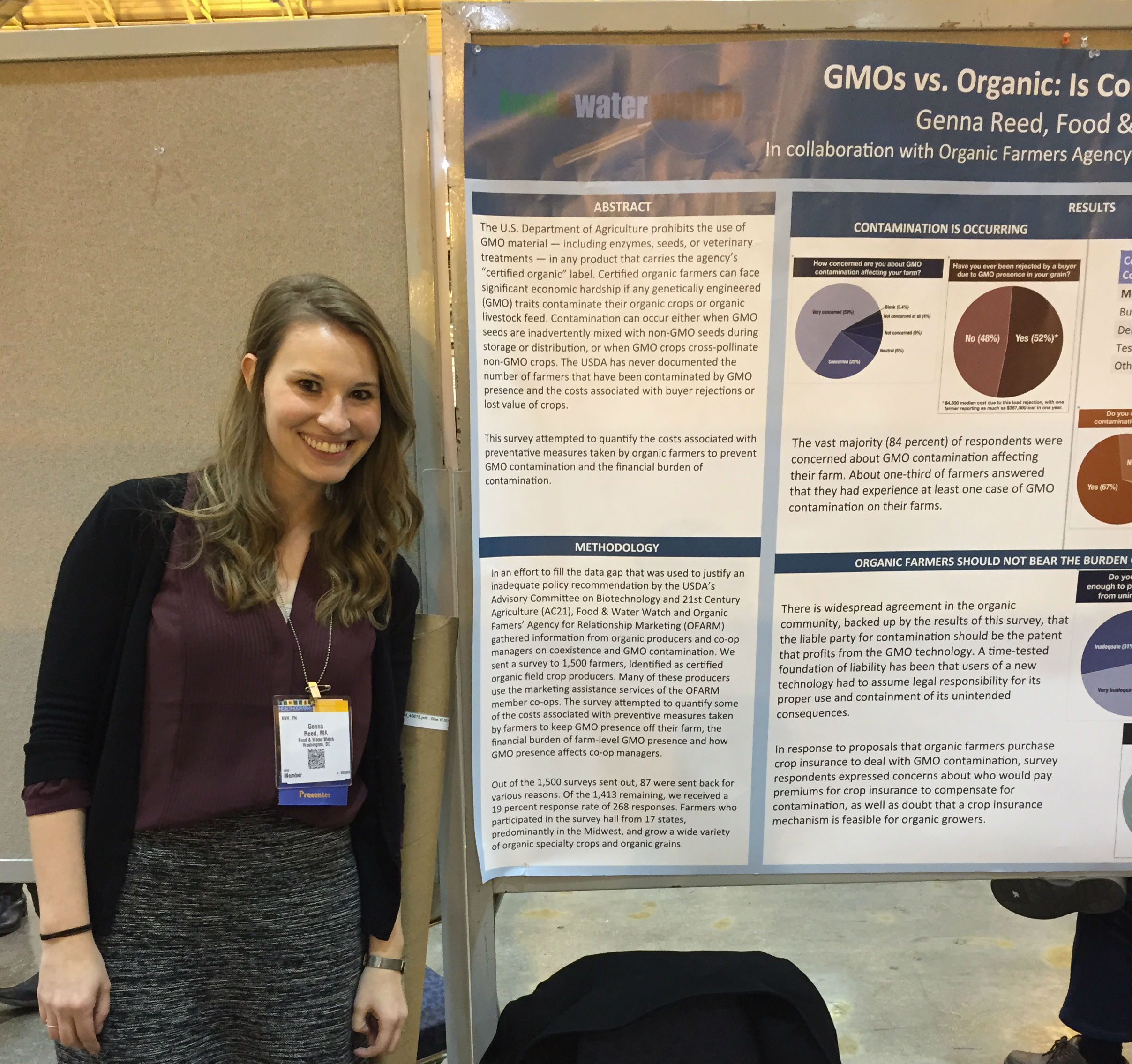
GR: I spend most of my time researching and writing materials (reports, issue briefs, fact sheets, op-eds, letters to the editor, blogs and testimony) that support our campaigns, specifically our GMO labeling campaign. I also work on federal comments on issues relevant to genetically engineered crops and animals and present our research at certain science and policy forums, stakeholder meetings and public hearings.
CJ: What are the three most important skills you need as a researcher?
GR:
1. Patience. It’s not always easy to find what you’re looking for.
2. Versatility. We have to be able to write about food policy to a range of different audiences.
3. Positive Attitude. Working at an organization that attempts to protect our food and water, we are up against very strong corporate interests, which makes it difficult to win our campaigns. We have to remain positive and keep on keeping on.
CJ: You research genetically engineered foods and the impacts that the technology has on farmers, consumers, and the environment. For people who are starting to learn more about genetically engineered foods, what are the most important things to know and keep in mind?
GR: The first thing I always tell people that are just learning about genetically modified foods, or GMOs, is that the way that this technology is currently used is first and foremost a moneymaking scheme for biotech companies that own seeds as well as the herbicides that are used with them. Herbicides are poisons, and their use has increased since GMOs were introduced. There are still many unanswered questions regarding the safety of GMOs and the herbicides that are used with them, and we have been the guinea pigs for this experiment since these crops and associated chemicals have been used for the past 20 years and foods made from these crops have been sold without labels the entire time. We should all be outraged at the lack of accountability and transparency from our regulatory agencies that have been keeping us in the dark about what’s in our food for far too long.
CJ: Food & Water Watch is an advocacy group with food, water, and environmental policy campaigns. Why do these issues matter to you and what can young people who are interested in these causes do to make a difference?
GR: There is not a single person in the world that is not affected by food, water and environmental issues. I have always believed that we have to take responsibility for the way in which we’ve treated our natural resources as commodities since humans began colonizing this planet. It’s high time that we begin thinking about the environment as having its own intrinsic value. Interested young people should get involved at the local level in their communities by getting educated on issues and joining with other concerned individuals to demand change.

CJ: Every day in your life must look different depending on your projects and the time of year, but what does a Monday look like for you?
GR: Monday mornings are spent drinking earl grey tea and going through my emails from the weekend and my to-do list that I’ve written on Friday afternoon. I start the day off finishing quick research tasks and then move on to longer-term projects as the day wears on. I try to do my writing either first thing in the morning or right after lunch, when my mind is the clearest.
Throughout the day, I usually have a couple of calls with our organizers on the ground to discuss campaign details and how we can work together to advance our cause or with representatives from other organizations who work with us in coalitions in order to build power to affect change. Hopefully by the end of the day, I have checked more things off the list than I have added.
CJ: What should a young adult who wants to be a researcher do now to set him or herself up for success?
GR: Having an inquisitive mind is a great way to begin preparing to be a researcher. Research is really just the process of finding an answer to a question or a set of questions. Another good skill to start honing is the ability to distinguish between good sources and questionable sources. It is essential that good research be backed up by solid fact and discerning between what is credible and what is not is imperative in this line of work.
CJ: What are some books, resources, and websites that have influenced you – either personally or professionally (or both)?
GR: E.O Wilson’s Biophilia was incredibly important in shaping and affirming my own opinions about the importance of protecting the environment and the role of humans in preservation. Aldo Leopold’s A Sand County Almanac was also very influential for me.
CJ: When you’re having a bad day, what do you do to reset?
GR: I usually go for runs to clear my head. After that, I spend time cuddling with my two cats, Jack and Willow, for comfort (if they’re in the mood, of course).
CJ: What are you working to improve upon – either personally or professionally – and how are you doing so?
GR: As a researcher with a dual monitor computer set-up, sometimes I find myself overwhelmed with inputs. Growing up in the age of multi-tasking and short attention spans, I sometimes struggle with devoting my full attention to individual projects as I’m working on them. I’m attempting to be more mindful of this and to fully immerse myself in one task at a time rather than spreading myself thin on a bunch of tasks.
CJ: What advice would you give your 20-year-old self?
GR: I probably would tell 20-year-old me to spend a little bit less time studying and more time exploring the state parks and natural beauty around Lehigh and farther out into Pennsylvania.

Images: Genna Reed