airplane w graphics
Travel

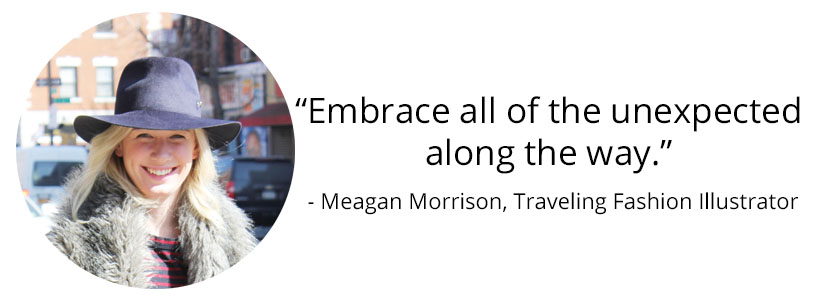
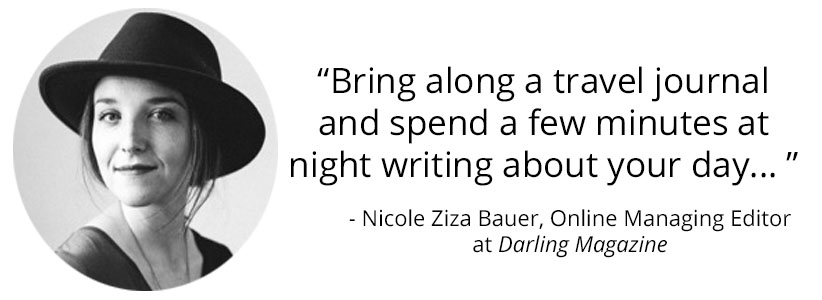
Now that we’re far enough into summer, you may have exciting trips planned for the next couple of months. As you research fun activities to do, pack your bags, and prepare for the adventures ahead, remember the words of wisdom from these five professionals. These people have traveled the world and learned from their mistakes, and they know what to keep in mind when it comes to exploring new territory. To read each professional’s full Spotlight, simply click on their photo.

travel roundup 1

travel roundup 2

travel roundup 3

travel roundup 5travel roundup 4

Image: Jose Martin with graphics by Carpe Juvenis

Meagan A
Professional SpotlightSpotlight

When we think of people who have inspired us, Meagan Morrison comes to mind for several reasons: she created her own dream job, she’s incredibly talented, and she’s contagiously optimistic. You can tell right away from seeing her illustrations how much skill Meagan has, and you immediately get drawn into her colorfully brushstroked world.

Though Meagan studied business in undergrad, it wasn’t until she was 24 that she decided to go back to school for a degree in fashion illustration. After doing internships and asking lots of questions, Meagan realized that she was going to have to create the dream job she ultimately wanted. The awesome and inspiring part? She did just that.

As a Traveling Fashion Illustrator, Meagan works with fashion designers and high profile brands and travels the world illustrating what inspires her. During our conversation, Meagan consistently referenced how much hard work it takes to make your dreams come true and that you have to “rewire your brain to think positively.” Very true words, and it’s encouraging to know that the road to your dreams may not be easy, but it’s definitely worth the challenge.

We’re excited to share with you Meagan’s interview with Carpe Juvenis! Read on to learn about her role as an illustrator, the greatest lessons she’s learned from starting her own company, and of course, how she seizes her youth.

Name: Meagan Morrison
Education: Bachelor of Commerce from McGill University; Fashion Illustration AAS from Fashion Institute of Technology
Follow: MeaganMorrison.com / Instagram / Twitter / Facebook

Carpe Juvenis: How do you define ‘Seizing Your Youth’?

Meagan Morrison: Making the most of every opportunity and asking tons of questions. Those who seek will find. Don’t wait for anything to fall into your lap, you have to go after it. Since I was very young I’d always ask a lot of questions to family friends and teachers. I was constantly educating myself and involving myself in things that I found interesting. ‘Seizing Your Youth’ is ultimately defined by each individual and what he or she wants to get out of life.

CJ: You received your Bachelor of Commerce from McGill University. What did you major in and how did you determine what to study?

MM: I went to McGill and studied business. My older sister went to McGill, as well. When I went to visit her, I remember looking at the girls in the commerce program and I loved seeing how they carried themselves. They were well dressed and professional. I really identified with them. They looked confident, empowered, and determined.

At the time I was very much into fine arts, but I wanted to step out of that for a bit to find myself and my purpose. I knew that with a foundation in business I could specialize and go smaller, but it would be harder to go from something narrower to a business degree. It felt like the right building block at the time.

Meagan D

CJ: You also received an Associate’s Degree in Fashion Illustration AAS from the Fashion Institute of Technology. What was that experience like?

MM: By the time I started my AAS in illustration I was 24 and really knew that the program was what I wanted to do. It was a highly specialized degree that offered fashion illustration as a two-year program. I didn’t want to commit to another undergrad degree, but I wanted a foot in the door in New York. I also wanted to be totally immersed in fashion illustration. I read this quote in a book about fashion illustration that advised to launch your career in a city that matters. I figured if I was educated here and given the opportunity to work here, I would be launching myself in the biggest city in the world for my industry. That’s what prompted my decision to go back to school.

Meagan Insta 3

CJ: What sparked your love of illustration and design?

MM: I always loved fashion and art. I didn’t quite know that they could co-exist so intimately until I started working in the fashion industry after McGill. My first internship was at a fashion magazine and I was constantly asking questions between the editorial department and the art department to see how much, if any, traditional art they used. It was predominantly graphic design and photography, so I didn’t see myself in that world. I thought maybe I belonged in the gallery world of fine art. Somewhere between trying out a bunch of different professions in the industry and asking questions, one of my coworkers mentioned the program in fashion illustration at FIT. When I heard the profession and researched it, it felt as though a lightbulb went off. I couldn’t believe that I found something that really combined my true greatest loves: art and fashion. That’s what really sparked the passion for me.

After hearing about the profession and the program at FIT, I went to bookstores and pulled all the sources I could find on fashion illustration. I searched through the glossaries and found names of illustrators, and some were located in Toronto. I reached out to Virginia Johnson, a local Toronto illustrator and textile designer, and brought her my portfolio. I explained to her that I loved illustrating shoes, and she pushed me to follow what I loved and told me that the rest would fall into place. I’ve been obsessed with illustration ever since.

Meagan Insta 2

CJ: You are a traveling fashion illustrator and recently branched out to start your own company. What does it mean to be a traveling fashion illustrator?

MM: It’s about being mobile and not just sitting at my desk pulling images off of the Internet. It’s about experiencing the culture firsthand and having that inspire my work. I have always been so passionate about travel and how that would inform my illustrations, and I wanted to be known as an illustrator at the intersection of both travel and fashion. There’s nothing like discovering a new destination and seeing how people dress in different cities around the world. I want to capture how the environment they’re surrounded by influences their style and my work. It’s the same thing when I’m at a fashion show and later do illustrations. I’ve seen the clothes, felt the texture of the fabric, heard the playlist, and felt the mood of the environment. I see the vision that the designer intends for the line. It helps bring the illustrations to life.

CJ: What are the greatest lessons you have learned from starting your own company?

MM: That you never stop fighting. Every paycheck is a fight. Every project is a new hurdle. I don’t mean to sound defeated by that, but it is the most obvious and striking contrast between working full-time and working for myself. I knew every two weeks I would get a paycheck at my last job, but now I have to chase and follow-up on everything. All the work of orchestrating that and keeping projects moving can be a challenge.

I’ve also learned that it would be great to have a sounding board. The thing I miss about working with a company is having the team to bounce ideas off of. It’s always a joint decision. I love the fact that I am making choices for myself and I do have the final say, but I think it’s good to discuss the decision with someone first and come to a well-informed decision. It’s a lot of pressure to not make the wrong choice on your own.

You also have to be careful so you don’t get taken advantage of. You’re constantly looking after yourself. The momentum has to keep going and the ball can’t drop. I find that the more I’m working, the more work comes in. It’s the ripple effect. The chain reaction in itself can be exhausting because when can you ever pause and catch up on your sleep?

CJ: You have done illustrations for amazing clients including Lucky Magazine, Rebecca Minkoff, Calvin Klein, and Conde Nast Traveler. When you work with each client, what is your process and your role as an illustrator?

MM: It honestly differs with every client, how big the project is and how much they want to involve the social and illustration aspects of it. When I come into a partnership I always gauge what the client’s expectations are, the breadth of the project, the timeline, their budget, and then we work from there. It’s about finding the middle ground between what you feel comfortable with and what the client feels comfortable with.

I have a clear vision about the brands I want to work with and how they align with the vision I have about being a traveling fashion illustrator. I don’t take on every project. If people want to sponsor things on my Instagram, I don’t take every product. Every partnership is very authentic. I don’t ever take on a job just for the money; I only do it when I believe it’s genuine and it makes sense.

Meagan C

CJ: How long does a piece take to create from start to finish?

MM: It varies per project and per client. For instance, my Calvin Klein job, I was at the show illustrating live. I could feel the fabrics and speak to the creative director, Francisco Costa, about his vision. I had about two days to turn around finals, but it helped to see the actual clothes. The pieces themselves takes me about three to four hours to complete, but that varies depending on how detailed each piece is. Then I scan the paintings, clean them up in Photoshop, and send the JPEGs to the client.

If it’s a customized piece or if I’m designing something from scratch, that requires a lot more preparation. I’ll do pencil sketches and color comps and then take it to the final round. Some are more laborious and expensive and others are just straight to final.

Meagan Insta

CJ: What should a teenager or young adult who wants to be a fashion illustrator do to set themselves up for success?

MM: Start asking questions and get a portfolio together. Also, don’t lose your voice. When people are younger they start to emulate the top people, but that’s not an advantage. People don’t want to hire a second rate version of someone else, they want to hire the first version of you. I’ve seen it on social media where people’s styles are so different, and that’s what’s standing out. It’s a saturated market. Keep true to you and keep your voice and style genuine. Embrace the quirks about your style.

There are tons of free websites out there as well where you can put your work online. Keep it clean and simple so you can showcase your work. When I was younger I was constantly illustrating to keep perfecting my craft and finding my voice. I wasn’t thinking about gaining clients just yet. Build your social awareness and share your journey. Then, when you are ready to work with clients, people will already know about you.

Meagan Insta 4

CJ: How do you stay organized and manage your time?

MM: I have a massive planner that is 8½ x 11 inches. I write lists every single day, and everything that doesn’t get accomplished the day before gets carried over to the next day. It’s blinding because I highlight everything. I also use whiteout so there’s nothing unnecessary on it. I start and end my day with that book.

From the planner I move to emails. The luxury of working for myself is that I can answer them when I’m in still in my pajamas. I get breakfast and then do errands. I want to get all my errands finished before I start painting, because once I start painting I lose track of time. It’s nice to have everything else taken care of so I feel at ease when painting. I don’t want stress to show through in the work. I often work pretty late into the evenings. It depends on how intense the turnaround time is. I like to end the day seeing a friend or unwinding watching Netflix.

One thing I’d like to do more of is exercise. You have to take care of yourself when running your own business. If you run yourself down there is no business. I don’t have weekends. I haven’t taken a proper vacation when I’m not working. For better or worse, travel has become part of my brand so I feel a sense of responsibility to cover what I’m doing and share it on social media even on my downtime.

Meagan Insta 5

CJ: What spring break experience has been memorable for you?

MM: I remember the spring break in my senior year of high school. I traveled with my class to France and Italy. That trip stands out to me because we had a small group of students in my high school, and we were combined with another high school group from the Ontario area. We got to meet new high school students on the trip and it was a prelude to university and meeting new like-minded people. I love how traveling and meeting new people expands your vision.

We started in Paris and hopped over to Florence and Rome. I had the time of my life. It wasn’t about the accommodations or amenities at all. It was about being with people you cared about, having a blast, and laughing a lot.

CJ: Is there a cause or issue that you care greatly about?

MM: Changing the perceptions on mental health, depression, and anxiety is important to me. I don’t think people should be scared to talk about it. Being open and dealing with it as you would your physical health is important. There’s more people suffering from anxiety and depression in the country today than there has ever been. Why is that? It’s a blessing and a curse that we have social media, but it also gives people a sense of inadequacy all the time. You’re constantly faced with what other people are doing and how much more you should be doing.

I’ve had to really practice changing my mindset about that. By nature I’m very anxious and hard on myself. I practice gratitude. My anxiety can be so bad that it could hinder my work flow. When things aren’t totally concrete I’m at my worst. The grey area is the hardest area to live in, but that’s life. Rarely is anything concrete.

CJ: What is your favorite book?

MM: Eat, Pray, Love: One Woman’s Search for Everything Across Italy, India and Indonesia by Elizabeth Gilbert.

CJ: What advice would you give your 20-year-old self?

MM: I’d say not to worry and that everything is going to work out just fine. I feel more confident now than I ever have. Looking back at all the things I didn’t think I could get through, that I have since surpassed, helps me to remember that everything will always work out. I didn’t know then that I’d be able to build a life that I love so much.

I would advise people in their twenties that nothing is handed to you. You have to practice happiness. It can be tough but you have to practice that in the same way you train for a marathon. Rewire your brain to think positively. Also know that happiness isn’t at the other end of success. You can start with happiness and then everything else doesn’t have so much weight on it. If your happiness is contingent upon getting into a certain college or winning a certain award or landing a client, then you’re never going to get there because the benchmark is always raised.

But if you start with being grateful with what you have in the moment, then you’re already working at an advantage. Be grateful for what you have because it can all be gone tomorrow. I feel infinitely happier now than I did way back then, even though I have tons more responsibilities. It’s been a matter of self-awareness and rewiring the way that my mind works.

Meagan M Qs

Images: Illustration Images by Meagan Morrison; photos of Meagan by Carpe Juvenis

Katie b
Professional SpotlightSpotlight

We fell in love with Katie Evans’ designs when we first laid eyes on them. It’s not hard to adore her bright and colorful designs. Having freelanced, worked at kate spade, West Elm, and Gap, Katie is no stranger to hard work and late nights. Now working as the Art Director at Ivanka Trump, Katie is involved with social media, editorial stories, and marketing. We were very excited to meet with Katie at the Ivanka Trump office in New York City, which is powdery pink and filled with inspirational images and quotes. We are motivated by Katie’s creativity and hard work, and we know you’ll be just as inspired.

Name: Katie Evans
Education: B.F.A. in Graphic Design from the Maryland Institute College of Art
Follow: @heykatieevans / katie-evans.com / ivankatrump.com

Carpe Juvenis: How do you define ‘Seizing Your Youth’?

Katie Evans: Taking chances and not being afraid to make mistakes. You’re young and now is the time to experiment with what makes you happy and what doesn’t.

CJ: You received your BFA in Graphic Design from the Maryland Institute College of Art. What sparked your love of design?

KE: I attended an arts magnet middle school and high school where I was a visual arts major concentrating in drawing, painting, and sculpture. In high school I continued those studies and did a crossover into the Communications department to take a graphic design class. CD album covers and booklets were what originally sparked my interest in design. I remember pinning them on my bedroom walls. I also designed a couple of covers for my friends’ bands.

When I was a junior in college, I still didn’t know exactly where I wanted to take my career. A professor gave me an assignment to spend a weekend collecting anything that I was attracted to. The next week I brought back a bunch of Martha Stewart’s Blueprint Magazines, editorial shoots from Lucky Magazine, and a bunch of fashion ad campaigns. My professor was like, “Duh, you should be in fashion.” I questioned her about how I could play a role in fashion as a graphic designer. She told me that fashion companies need graphic designers – they do the windows, the packaging, and the hangtags, etc.

Katie c

CJ: You are the Art Director at Ivanka Trump. What does your role entail?

KE: Ivanka started her licensee businesses a while ago, and she recently hired a small team to revamp and bring new life to the brand. We recently launched our new site, ivankatrump.com, that includes articles on work, style, travel, home and play.

I concept all of our editorial content on the site and our social media channels. Everyone does a bit of everything here because we are so small, which is great because you can be involved with different aspects of the brand. Our team makes all of our ideas come to life. I still do graphic design which I think a lot of Art Directors don’t do anymore. It keeps me on my toes.

CJ: You freelanced as an Art Director, Graphic Designer, Illustrator, and Consultant for years while also maintaining jobs. How did you go about securing freelance work, and what advice do you have for those interested in freelancing?

KE: I originally started freelancing because I needed the extra money. I always had a steady job and paycheck to fall back on, and freelancing let me experiment and find out what worked and what didn’t. For my first freelance job, I was paid $500 to design 10 different stationery cards for a new company. Looking back on that now is crazy to me. I want to smack my 22-year-old self and ask what I was thinking! I spent so much time on those cards. It should’ve been $500/per design. When I figured out what I wanted my freelance projects to be, I was able to pick the ones I liked the most. Most of my jobs came from word of mouth with a mix of referrals from social media and LinkedIn. I did freelance as a career for a little bit, and then Ivanka Trump lured me back into the corporate world.

If you’re thinking about going strictly freelance, you have to be passionate about what you’re doing. You have to be a go getter or you will go nowhere. You also have to be organized because now you are a bookkeeper, assistant, answering emails all day, and you still have to pump out the creative. It took time, but I was able to figure out how long projects would take me and account for client feedback to get it all done in time to start my next project. It was tricky to find that right calculation, so being flexible was important.

When I first went full-time freelance, I had nine clients. It was a disaster on my side, but I put on a good face for my clients. I had no social life, I was overworked, and I will never make that mistake again. I think the happy medium was 3-4 clients, with 2 recurring clients and 2 rotating projects. I had to be very strict with my clients about deadlines so that it didn’t interfere with other jobs.

women who work

CJ: How did you stay organized and efficient while balancing freelancing with your corporate jobs as a Graphic Designer?

KE: Google. Google has helped me do everything. I used spreadsheets for my bookkeeping and the calendar for meetings and deadlines. I would have each client assigned a different color so I could visually see the different projects I had. It worked because I could access those files from wherever I was – whether it was on my computer or phone.

CJ: You’ve worked as a graphic and web designer at some amazing places such as kate spade, West Elm, and Gap. What are your biggest takeaways from these experiences?

KE: The biggest thing I learned was that if I’m not passionate about the brand and what I’m marketing, I can’t do my job 100%. At kate spade, I lived and breathed that brand. The projects were so much fun. The kate spade team was very small so I was able to get my hands on everything, from window installations to stationery collections to working on photo shoots. I loved that so, so much. Every day was different and I was building a great portfolio.

The other companies I’ve worked for were much larger and at those jobs I was hired to do one thing and that thing only. They had huge teams to do everything and I realized through those experiences that I thrive better in smaller environments where I can play a part in all aspects of a project. I like to see things from start to finish.

CJ: What is the best part about being a designer? The most challenging part?

KE: The best part is telling stories. Just being able to tell a story about what a girl is doing and what she’s wearing and what she’s thinking and feeling. Finding a way to bring that story to life is the best part.

The most challenging part is finding the balance between making something beautiful but also selling that product. It’s tough to be conscious of both.

Katie a


CJ: Every day in your life must be different depending on your projects and the time of year, but what does a Monday look like for you?

KE: 7am: Rise and shine! Go for a run! #TeamIvanka is training for a half-marathon in April. Most of us are new runners and can’t imagine running 13 miles. So far 4.5 has been my most.

9am: Take the F train uptown. Read theSkimm on my ride up.

10am: Write out my to-do’s for the day. Respond to emails.

10:30am – 2pm: Plan our next editorial shoot, pull inspiration, select models, snap a photo of Ivanka for Instagram, and edit videos.

2:00pm: Lunch! If I eat too early the day goes by much slower.

2:30 – 5:30pm: Work with our Editorial Director to plan the next month of stories. Call people and brands that we want to collaborate with, design creative for our social media channels, a little bit of pinning to Pinterest.

5:30 – 6:00pm: Regroup with my creative team to make sure we’re meeting deadlines.

6:00pm: Out the door!

Trump Tower

CJ: What should a teenager or young adult who wants to be an Art Director or Graphic Designer do now to set themselves up for success?

KE: Be multifaceted in your line of work. If you’re a graphic designer, take a variety of art classes and learn as much as you can. You’ll be more valuable to your employer. As a designer, explore print, packaging, publication, digital, and visual. It will set you up later in your career to think about a project holistically.

Also, be nice. It still blows my mind how small this world is.

CJ: What is your favorite book?

KE: I just finished reading You Before Me by JoJo Moyes. I laughed and cried.

CJ: Having a loaded schedule can sometimes be overwhelming. What do you do when you’re having a bad day and need to unwind or reset?

KE: I like to take deep breaths, go to the gym, and shop.

CJ: What advice would you give your 15-year-old self?

KE: Your career path is going to be hard work, but it’s going to be worth it. And pay attention in your foundation art classes! Find a way to enjoy it and embrace your art style. You may think they’re boring, but they’re teaching you the basics of art that will come up in every aspect of your job.

Katie Evans Qs

Image: Carpe Juvenis

Professional SpotlightSpotlight

We discovered Moni Yael Garcia by happy universal chance. While stumbling through the internet we landed on an amazing site called Real Heroines and were immediately mesmerized. The graphics, the stories, the layout - everything captured our attention and we needed to know who the mastermind behind it was. We are excited to introduce Moni Yael Garcia, freelance designer, illustrator, and entrepreneur extraordinaire! From web design, to photography, to mobile, to identity development, Moni does it all (and makes it look effortless!). We asked Moni to describe her work as a self-starter and where her life and creative inspiration comes from.

Name: Moni Yael Garcia
Occupation: Freelance Designer and Illustrator
Age: 27
Education: University of Texas at Austin
Follow Moni: Website | Twitter | Instagram | Dribbble

Carpe juvenis: How do you define “Seizing Your Youth”?

Moni Yael Garcia: Enjoying your time as an individual where responsibilities are few and self exploration leads to personal epiphanies.

CJ: What originally drew you to design and illustration?

MYG: I’ve always had an interest in art and drawing. Even before kindergarten I would sculpt roses out of Play-Doh and dinosaurs out of aluminum foil. I really enjoyed experimenting with colors and drawing what I saw in picture books. I found these things relaxing and the only way to accurately understand myself and the world around me. I never considered design or illustration as a sustainable form of living. I went through various career choices from grade school to high school, and becoming an artist was never something I considered possible. Even though both my parents are creative individuals their careers have followed more traditional paths. Luckily, I came across the “graphic designer” occupation during a career research project for my 11th grade BCIS class. That’s when all my tension on choosing a career dissipated, and I finally had a direction I could wholeheartedly follow.

CJ: After graduating from University of Texas in Austin you struggled to find footing in the professional world – what made you decide to invest your time into late night tutorials and, in hindsight, was it worth it?

MYG: Late night tutorials were the only thing that kept me sane after graduating from UT. It was such a tough time for me. I couldn’t find a job for almost a year due to the competitive nature of the industry and the recession. The majority of places were under a hiring freeze and if they were looking for new employees, having no experience in the field just didn’t cut it. I only had one real internships under my belt and my skill level was bare minimum. Don’t get me wrong, my education in the University of Texas Design Program helped me immensely and gave me an understanding of design, the importance of concepts and the creative process. However, I needed more experience and a chance to level up my abilities as a designer. I actually treasure these obstacles now. They drove me to push through, take initiative, and reevaluate my goals.

CJ: What was the main trigger that made you realize that the corporate environment wasn’t for you?

MYG: I would say the differences in our creative process. The pay was great, and the hours were predictable, but I found myself constantly frustrated in the way things were approached. Then after several months of trying to make it work I had a heart to heart with myself. Would I be happy working there for the next five years — heck even two? Did I see myself growing into the designer I wanted to be or would I fall into complacency? Would it be okay to go to a job that I would eventually come to hate every day? I saw no progress in site and that’s when I decided to make a change professionally.

CJ: What inspired you to create a personal website, and how has that affected you professionally?

MYG: The reason I decided to create my own personal website instead of using a standard template was because I felt it necessary. I wanted to showcase my work, creative skills, and personal story in an unconventional manner. I was ready to step out of my current situation and become a full-time freelancer. It was definitely a challenge filled with stress during the whole process, but ultimately I knew it would lead to my new identity. I strongly encourage all creatives to have their own website, or at least some form of a digital portfolio where they have the ability to showcase their own work. Behance, Cargo Collective, and WordPress are great places to start if developing your own custom website from scratch isn’t possible.

CJ: Can you please tell us more about your volunteerism work with the Boys and Girls Club Holthouse?

MYG: Well, for a couple of years I had the opportunity to share my Fridays with a group of 7 to 11 year olds at one of the Boys and Girls Club of Greater Houston. I wanted to make the most out of my visits with these kids, so we set up “Club Tech”, in which we covered business, art, design, programming, and robotics. Basically everything I learned during and after college. I wholeheartedly believe it’s important to give back to others who may not have certain opportunities or resources available to them due to circumstances out of our control. Exposing younger generations to these subjects early in their development sets them up for success. I really tried to create a curriculum that encouraged creativity and problem solving. At times it was difficult to motivate them through a project though, since they already had a long week of school, but they were real troopers. Some of our favorite activities were, creating business cards for their fictional business, building real working cardboard robots, 3D printing figurines, and designing their own computer game. As long as I was able to open up a new world for one of those kids, I’m happy.

CJ: What advice would you give to younger artists/designers/illustrators who are still studying their craft?

MYG: Five things. 1) Don’t overlook the history of your profession. It’s always a good idea to study the basics and build a strong foundation. 2) Dissect the world around you and don’t be afraid to recreate work you find inspiring. (Just don’t claim it as your own!) 3) Explore different concepts and techniques that spark your interest by jotting them down and finessing them through whatever medium necessary. 4) The more you make the more you learn. It’s easy to get discouraged when you’re in a competitive field, but nobody starts awesome. You need time to develop your skills and even find your passion. 5) Posting your process on a social media outlet is a great way to document your journey and can even help you land possible internships or jobs.

I think if you keep these things in mind you’ll be able to find your own voice and make great things.

CJ: How do you create and maintain a work-life balance?

MYG: Honestly, I’m still working on that. As a sole proprietor it’s up to you to find work, manage clients, execute projects, and develop your business. It can be stressful and rewarding at the sametime. My personal time almost always relates to my business time, though indirectly. Whether it be daily exercise to get my creative juices flowing, hiking expeditions as a form of self reflection, designing products for my online shop that require a more personal approach, and even sleeping to work through mental blocks. I like to use this time as fuel for what I do and want to accomplish. As I see it, let the way you live your life dictate how you approach your work.

CJ: As a self-starter, how do you keep yourself on-track with goals and deadlines?

MYG: Having a scattered “To-Do” list with no unforeseen end can be daunting. That’s why I’ve switched over to organize my priorities with a project checklist where I have the flexibility to assign daily, weekly, and monthly tasks. I plan out all my client work and personal projects in Producteev, a free online management software, and move on to display my weekly and daily tasks throughout my workspace. I’m a very visual person so seeing things I have to accomplish outside of the screen and on my whiteboardand post-it notes keeps me focused. Overall this process allows me to change between projects and stay productive when I’m burnt out with one in particular.

Moni Garcia QsCJ: Where did your love for women’s rights come from?

MYG: I can’t really pin point where my strong interest for women’s rights came from, but I’ve always been fond of encouraging others to reach their full potential, whether they be women, men, boys or girls. We’re all human and treating someone poorly due to gender, ethnicity, religion, sexuality, disability, or social status is baffling. Equality encourages a future of strong innovative thinkers and leaders, better economy, more creativity — not wanting everyone to be equal is just a stupid outlook.

CJ: How do you strive for equality in your everyday life?

MYG: Innately we all yearn for personal equality and acceptance. However, a constant barrage of negative comments and imagery can distort anyone’s understanding on how to treat others and even themselves. Personally, I stay true to my own convictions and openly express my concerns on issues that impede equality. Education on the subject is extremely important and in most cases allows people to reevaluate stereotypes they perceived as true. That’s why on August 26th my partner and I launched Real Heroines: an on going web project that compiles notable women who cultivated their minds and overcame adversity by defying social conventions. Through this site we hope to inspire female empowerment within men, women, boys and girls, from the action of their predecessors, so we can all move beyond gender stereotypes and grow as people. Education and an open mind brings awareness on equality, or any issue, really.

CJ: Growing up you were raised in a household that provided you with two different cultures – how did those experiences shape who you are as an adult?

MYG: I value knowledge and education and have a strong work ethic, but that’s more from being raised by a teacher and an engineer than being a second-generation Mexican-American. Growing up bilingual made me create a sort of pidgin involving a mixture of words and sound effects to express myself. Being the product of two cultures provides a perspective on problem-solving that neither culture might have on their own.

CJ: What is your favorite way that technology has changed over the past five years?

MYG: We’ve refined technology for so long that it’s much more accessible to individuals rather than only large corporations. This accessibility allows us to further integrate it into our society. An individual can now use technology to create something they’ve imagined with a degree of polish that used to only be possible with a team of people or large-scale machinery. 3D printing is a great example. And the whole thing is cyclical. The more we adopt, the more we refine, which in turn integrates it further into society.

CJ: What advice would you give to your eighteen-year-old self?

MYG: Take risks, stop waiting! Allowing your school curriculum to dictate your every move will only hinder your growth. Take the initiative to apply for internships, seek mentors, and invest in personal projects. These experiences will feed your creativity and raise your skill level ten fold before you graduate from college. Welcome obstacles that come your way and then kick them in the shins!

Image: Courtesy of Moni Yael Garcia

a
Professional SpotlightSpotlight

It’s not every day that we see an illustration, design, or logo that makes us feel something. However, when we see Kate Harmer’s illustrations and designs, we are immediately inspired and moved. Kate drew constantly when she was a little girl and she hasn’t stopped since. After following her passion and enrolling in Cornish College of the Arts, doing internships, getting job experience in design and illustration, and completing graduate school at Rhode Island School of Design, Kate launched her own design studio, Hum Creative, that focuses on creating and developing brands. More recently, Kate illustrated a fun book based on the popular Twitter feed @tweenhobo.

Kate is not only amazingly talented, but she is smart, kind, and thoughtful. We are encouraged by her self-starter attitude, work ethic, and of course, her creativity. Kate not only has the ability to draw and design, but she also knows how to build an incredible team of people with serious creative skills. Through determination, hard work, and learning how to grow a thicker skin, Kate has excelled in her field, and she generously shares the lessons she has learned during her journey. Read on to learn more about Kate Harmer, a true inspiration!

Name: Kate Harmer
Age: 32
Education: BFA in Illustration from Cornish College of the Arts; MFA in Design from Rhode Island School of Design
Follow: Twitter / Hum Creative / Instagram

Carpe Juvenis: How do you define ‘Seizing Your Youth’?

Kate Harmer: It’s common to hear successful people look back and say, “We were so young, we were so crazy, we were so brave!” They’re talking about times that were challenging, but they are able to look back and laugh. I try to remember that I’m in that time right now for my future self. Knowing that all of these things won’t seem as hard or scary once they’re done encourages me to take big risks.

Yes, I’m 32, but that’s super young! Someday I’ll hopefully laugh at my failures and be proud of having challenged myself. Both are positive outcomes. To me, seizing your youth is embracing that now is the time to be free and brave.

CJ: You received your BFA in Illustration from Cornish College of the Arts. How did you determine what to study?

KH: My career has been a process of elimination. When I was in high school I didn’t know what graphic design was. I just knew that I liked to draw and wanted to do something creative. I went to school for Illustration and worked as an Illustrator for a while. I tried to follow my passion in a broad sense, then tried lots of things to see what I enjoyed and to get more focused.

CJ: What sparked your love of illustration and design?

KH: As a kid I would sit in my bedroom for hours and draw fake advertisements for the commercials I heard on the radio. I didn’t realize it at the time, but I was thinking like a graphic designer. I wasn’t super social, so drawing was a natural way for me to process the world and express myself.

Because I drew constantly, I had good foundation of skills by the time I was looking at colleges. I definitely think most things can be learned, but you have to put in the time.

d

CJ: You also received your MFA in Design from Rhode Island School of Design. Why did you decide to go to graduate school, and would you recommend it?

KH: I went to graduate school to learn new skills and jump start the next phase of my career, which was more about design than illustration.

I would recommend graduate school, but only for people who are really ready for change and have fully explored on their own first. I don’t think graduate school is required to be successful, and some life experience first is key. You can create a condensed learning experience on your own, but some people need help. I needed grad school to push me.

Graduate school was both awful and great. The workload was almost unbearable at times, making it one of the toughest experiences of my life so far. It was a critically intensive, so I graduated with a much thicker skin. I also made amazing friends, learned a ton, and I felt empowered to do what I do now. It was a full, amazing experience.

CJ: You are the Principal and Creative Director at Hum Creative. What do your roles as Principal and Creative Director entail?

KH: When I first started the company I was doing a bit of everything – designing, sweeping floors, and writing invoices. Now my role is to think about this entire company as a design project. I am responsible for our overall strategy and goals, getting the best team of people together, and directing the creative process. I also play on our kickball team.

CJ: Before Hum Creative, you were a designer at Starbucks Creative Group. What kinds of projects did you work on at Starbucks?

KH: I got to illustrate coffee bags, draw lots of little croissants and coffee mugs, and help design seasonal merchandise and packaging. I was fresh out of school and supported senior designers and creative directors with illustrative tasks that were needed to fulfill their vision.

I think about that job every day while building Hum Creative. When I was at Starbucks, it really felt like everyone was happy with their jobs and coworkers. A lot of what I learned there has stayed with me.

e

CJ: You illustrated the book Tween Hobo, which is based on the popular Twitter feed @tweenhobo. What was that illustration process like?

KH: Alena Smith knows the Tween Hobo character so well. I flew down to LA to brainstorm initial ideas for the book with her, then worked remotely for the next few months. Alena sent me in-progress chapters every couple of weeks. I would read them and keep a running list of possible visuals. We would Skype to discuss and narrow them it down. Most of the process was brainstorming with Alena. I would sketch the illustrations in pencil first, and then once they looked good I drew over them in Sharpie.

CJ: What are the greatest lessons you have learned from being an illustrator and designer?

KH: Professional creatives need to be open to criticism and flexible to change, but they also must stand up for what they believe in - when it really matters. Grad school and client work has helped me grow a thicker skin and to understand that everyone’s input is valid. You can’t be too precious about your work – sometimes people won’t like it. That’s okay. Not all battles are worth fighting… when you do push back, it should mean something.

CJ: What is the best part about being a designer?

KH: The best part of designing for me was seeing my work out in the world, successfully doing its job. As a creative director, it is so fun to see this whole group make work that they’re proud of. Knowing they worked hard, made beautiful work, and enjoyed the process is hands down the best part about what I do.

CJ: What does a day in your life look like?

KH: My day involves a lot of time reading emails and meeting with our internal design teams to check in on projects moving through the studio. I also meet with clients often to present work and discuss feedback. Some days are spent on the set of photo shoots or visiting the printer for press-checks.

c

CJ: What should a teenager or young adult who wants to be an illustrator and designer do to set themselves up for success?

KH: Make a lot of work. We look at a lot of portfolios here, and the people who really stand out have been making up their own projects and designing things on the side. Drew Hamlet, a Lead Designer at Hum, started an online radio station in high school and he designed the branding, website, and collateral for it. I’m very impressed by self-motivation. You learn so much by just being active in your field, even if it’s just practicing. Don’t wait for people to ask you to do something, just do it yourself.

It is also important to have a sense of the design community and what has come before you. Look at blogs, read design books, and absorb a design education as much as possible.

CJ: How do you like to spend your free time?

KH: I work long hours and am a homebody when they day is over. My husband and I love to cook and enjoy big dinners outside, then take our two French bulldogs on long walks.

CJ: What motivates you in your everyday life?

KH: Professionally, this team motivates me. The responsibility of having people who come to work in an environment that I make is both very intimidating and very inspiring.

My husband is very motivating and inspiring outside of work. He is a creative that has worked really hard since he was a teenager and he’s done well. He’s always wanting more and imagining fun things he can do. He’s constantly learning and dreaming. He’s a really good reminder to keep your mind open and active.

CJ: What advice would you give your 15-year-old self?

KH: I’d tell myself to be braver sooner. It took me a little while to start realizing that taking risks almost always pay off in some way. It might not always be in the way you planned, but taking on challenges is the fastest way to grow.

Kate Harmer Qs