late winter
CultureLearn

With low temperatures and high winds keeping you inside, you’re going to need some reading material. These great reads make late winter look pretty darn appealing…

late 6THE GIRL ON THE TRAIN BY PAULA HAWKINS

We’re excited to read this novel about a woman who sees something
shocking during her commute on the train. Reminding us a bit of
Agatha Christie’s Murder on the Orient Express (because of the mystery
and the train, of course), we look forward to being completely consumed
by this story.


late 5

ALL THE LIGHT WE CANNOT SEE BY ANTHONY DOERR

This novel about a blind French girl and a German boy whose paths
collide in occupied France as they try to survive the devastation of
World War II looks powerful and emotional.


late 3FUNNY GIRL BY NICK HORNBY

Author Nick Hornby is back with Funny Girl, a story set
in the 1960’s in London and follows the adventures of
an innocent young woman and her transformation into
a television starlet.


late 2LAUGHING WITHOUT AN ACCENT: ADVENTURES OF
A GLOBAL CITIZEN BY FIROOZEH DUMAS

Firoozeh Dumas explores her Persian heritage and shares
stories about her family, culture, and being a citizen of the world.
Dumas’s wit and insight makes this book look like a humorous
and fun read.


late 7WE MAMMALS IN HOSPITABLE TIMES BY JYNNE DILLING MARTIN

This book of poetry looks captivating. Jynne Dilling Martin spent six
weeks living in Antarctica shadowing scientists and writing about
what she witnessed. We’re already hooked.


late 10 TO KILL A MOCKINGBIRD BY HARPER LEE

We can’t help but love this classic novel from our childhood.
Author Harper Lee is releasing her anticipated novel Go Set a Watchman
in July 2015, and we can’t wait to re-read this beloved book.


late 9 THE GOOD EARTH BY PEARL S. BUCK

Pearl S. Buck writes a beautiful and painful story about China
in the 1920’s. The story of farmer Wang Lung and his wife
O-Lan spans decades, and the changes in history and tradition
are apparent as the years pass.


late 8AND THE MOUNTAINS ECHOED BY KHALED HOSSEINI

We loved The Kite Runner so much, and it’s almost embarrassing
that we haven’t yet read Hosseini’s newest novel. Hosseini
explores the way families nurture, betray, and sacrifice for
one another.


What’s on your late winter reading list?

reads 1
CultureWeekly Reads

reads 1

These are the articles #TeamCarpe read and loved this week. What did you enjoy reading?

Inspire

A great response to a bully? “I love what you’re wearing.” This is what a teenager from Oregon is teaching kids: how to battle bullying with kindness.

Save

Love being online? Being plugged-in for hours on end can cost you.

Sleep

Having trouble falling asleep? Use the 4-7-8 breathing trick.

Read

The Science of Shakespeare: A New Look at the Playwright’s Universe by Dan Falk examines how Shakespeare was influenced by observational astronomy. Shakespeare and science? Looks like a fascinating read to us!

Innovate

This TED talk from Jack Andraka, a teenager who developed a promising early detection test for pancreatic cancer, is sure to inspire you.

Try

Try these seven habits of optimistic people. Who knows, you might just find yourself smiling more!

Image: Carpe Juvenis

2015 goals
CultureSkills

The New Year has come! It’s time for… New Year’s resolutions. Yikes. For some, this means eating healthy. For others, it means going to the gym more. It can be saving money, getting better grades, cutting down on the caffeine, or even finally cleaning out your closet!

But there are some unique resolutions that you might not have thought of that can be pretty fun!

Alphabet Book Checklist

Read a book with the title starting with each letter of the alphabet. Twenty six books, 12 months, about two books a month. You never know what you may find. Make a checklist of the things you’ve been wanting to read (romance novels, nonfiction short stories, poetry, anything!) and go to your local bookstore. It’s a low key resolution, no stress, just a small thing you can do for yourself.

Eat the Rainbow

No, not Skittles. I mean, eat each color of the rainbow. This might be kind of silly, but it’ll make you eat a variety of foods. There’s probably a health thing out there somewhere, but for you, it should be something that’s fun! You can try to eat the rainbow every day, or maybe split it up to make it a weekly goal. Fruits, leafy greens, meats (or not, if you’re a vegetarian), grains. For more challenging colors like blues and purples, you can say browns, like bread. I never ate quinoa (pronounced kinwa) but once I tried it, I discovered how yummy it was!

Stand Up Straight

Yes. You heard right. Stand up straight! I never realized how much I slouched until I started wearing heels. Then I realized that my balance was way off, and it was evident in the way my back and chest hurt from being pushed back into its original upright position. Commit to standing up straight when you’re waiting for the bus, when you’re in line at the grocery store, even when you’re showering. Do the Superwoman stance, with your hands on your hips and head facing forward. Over time, your body and your mind will develop and strengthen. Think about how confident you feel now, and how much more confident you will feel after you learn to hold your head up high. At the very least, this will sort out your backaches.

These are a few low-key resolutions you can take on. Read a bit more, eat better, try new things, boost your confidence. Whatever you’re comfortable with, do. Whatever scares you a little, try. Whatever makes you happy, go for it! Have a great new year!

Image: sanazmy97

Emily c
Professional SpotlightSpotlight

Meet Emily Armstrong. She’s sweet, thoughtful, and insanely talented. At just 23 years old, she is a graphic designer at Barneys New York and is tasked with projects such as creating woodland creature masks for children, designing posters for brand invitations, and collaborating on exclusive cosmetic bags that are incredibly chic.

Passionate about art and illustrating, Emily raves about modern art, her love of design, and how she one day hopes to live in Paris. She is a big-time reader and loves to spend her free time at The Strand. We’re big fans of Emily and her work, and we love the best advice she’s ever received: ‘Make yourself proud every day’ and ‘Focus on your cool.’ It’s pretty obvious that she’s got the cool part down pat.

Name: Emily Armstrong
Age: 23
Education: B.F.A. in Graphic Design and Drawing from the University of Missouri-Columbia
Follow: Blog / Portfolio / Instagram

Carpe Juvenis: How do you define ‘Seizing Your Youth’?

Emily Armstrong: I realized that when I was in school, I had such an advantage. People were more likely to reach out to me because I was a student and young. They were willing to share advice because they didn’t see me as competition yet. Seizing my youth meant realizing that I was at such an advantageous place and not letting that hinder me but taking advantage of it.

CJ: You received your BFA in Graphic Design and Drawing from the University of Missouri-Columbia. What sparked your love of design?

EA: My love of art came before my love of design. Art started for me when I was very young. In second grade I was drawing caricatures of my classmates. I realized that I liked to draw clothes and people, but design came later. In college I decided to study art, and my parents were a little hesitant. They introduced graphic design to me as a more marketable skill. I ended up loving it after I took a few classes. Those classes sparked my love for design.

Design is everywhere. The visual language is more personal when you’re so close to design.

Emily A 1

CJ: What was your favorite class in college?

EA: I loved multicultural literature. We read a book about a different culture every few weeks and discussed it and gave presentations. I love reading, and I think it’s a romantic skill and related to art from a storytelling aspect.

I liked my beginning physics class a lot.

My favorite class was my portfolio class. Our first assignment was to create 20 images in any medium, and we only had a couple of weeks. The professor just wanted us to start hashing out our ideas that we had built up and to not overthink the images we were making. I ended up with a lot of cool images that I’m still proud of even though it was my junior year in college. I’m inspired to continue adding on to that body of work.

CJ: You are a Graphic Designer at Barneys New York. What does your role entail?

EA: I’m a print graphic designer, so I make our print collateral - things from signage in the stores to books and catalogs in the mail and invitations for events. I can be really creative with these projects. For example, if a designer uses a print in their collection a lot, we might pull that image and make it a liner in the envelope. I love seeing the finished product and having it in your hands.

Right now I’m working on a special project that is in collaboration with Baz Luhrmann, and I get to do some fun drawings. I drew masks of woodland animals for children who come visit the stores. Barneys gives me the freedom to use my skills and have freedom with my work. I’m so excited to be a part of the Baz campaign – he’s a hero of mine.

Emily A 5

Emily A 4

CJ: You’ve interned at some amazing places such as Donna Karan and Barneys New York. What are your biggest takeaways from these experiences?

EA: A lot of my experience with Donna Karan was really about New York. It was about getting acclimated to New York as well as the internship. No one thought it was lame that I was from Missouri – I thought I was going to stick out like a sore thumb.

I felt really empowered by the city and having this internship. I had never learned about fabric before, and my internship was in the fabric department. They would give me a swatch of fabric and I had to source it in the city. I had to find a similar weight and content of that fabric swatch with a specific price point. I was set free to do the project, and while that might seem overwhelming, to be able to complete a task like that and do it well was the most empowering thing. Donna Karan was about me feeling confident with myself and in the city.

My Barneys internship was instrumental in getting my job now. Because I had the New York experience before, I learned a lot of skills and how to be detail-oriented. I was learning from the best, and this internship was helpful with my aesthetic sensibility.

Emily A 2

CJ: You were a Student Ambassador for Stylitics, the largest digital closet platform on the web. What were your duties as a Student Ambassador?

EA: That was such a crazy chapter in my life because during my first summer here there was a Parsons program put on that I attended. At the networking brunch, I met the founders of Stylitics and they asked me to be a part of this program. My duties were to spread the word about Stylitics, so I did street style photography on-campus, I talked to student reporters, and generated buzz for this company.

The founders wanted to start a high school program, and my sister was in high school at the time, and I offered to help make a promotional poster. A reporter from the Wall Street Journal saw my poster and she reached out. The conversation was about Stylitics and the ambassador program, but I formed that bond with her and ended up being in that huge newspaper.

CJ: What is the best part about being a designer? The most challenging part?

EA: I love arranging elements, making beautiful compositions, and making textures with text.

The most challenging part is my tendency to always want to illustrate everything. I can’t help it. Restraining myself from illustrating, creating something graphic, and working with type.

CJ: Every day in your life must be different depending on your projects and the time of year, but what does a Monday look like for you?

EA: I like to wake up a little early at 8am so I can make my French press coffee and bagel, and then take some time to read. I get ready, take the train to Rockefeller Center. Recently I’ve been working on a brand’s invitation and poster. After work I love going to yoga. I encourage everyone to do yoga – you get strong, healthy, and energized. Then I go home and eat leftovers.

Emily A 6

CJ: Having a loaded schedule can sometimes be overwhelming. What do you do when you’re having a bad day and need to unwind or reset?

EA: I try not to let it show in the office ever. After work it’s nice to do some cardio so your brain can be free. Taking that energy from the stress and replacing it in a better way is so important.

CJ: What is your favorite book?

EA: Just Kids by Patti Smith or 100 Years of Solitude by Gabriel Garcia Marquez.

CJ: What advice would you give your 15-year-old self?

EA: If you don’t like volleyball, that’s okay. Focus your attention somewhere else. You don’t have to be the best at everything. You should not feel lame about wanting to do art, embrace the music you like, and don’t be overwhelmed with social situations. There’s a huge reset button when you graduate high school. Do the best you can and not be wrapped up. I’m so happy for all the reset buttons in my life!

Emily Armstrong Qs

Images: Emily Armstrong; Lauren Jessen

books
Culture

1. Holidays

The obvious: it’s holiday season. You may celebrate Christmas or Hanukkah or just plain old New Year’s Eve. December means shopping. It means pigging out on all year-round-forbidden foods. And it means seeing family and friends and reconnecting with those who you have maybe lost touch with throughout the entire year. I see December as a month of reunion.

2. Hot Drinks

Don’t tell me you don’t participate in PSL season. Okay, if you had to look up PSL, maybe not. Either way, we all know there is nothing more comforting or satisfying than sipping on a searing cup of coffee, tea, or hot chocolate in cold December. It is the time where coziness reaches its climax. Drinking away your calories is acceptable, but only in December.

3. Smell

December has a smell - that is fact. It smells like cinnamon. It has the aroma of pine trees. And it has the faint scent of deliciously baked goods. Am I wrong?

4. Winter Clothes

Summer is definitely a desired season, but during this time you can finally dress in sophisticated coats and elegant scarves that you’ve secretly been waiting to wear all year long. It’s cold, but not cold enough where you’re forced to wear bulky parkas. Also, it calls for some fun when putting an outfit together - scarves, boots, pants, jackets, ear muffs, hats, and gloves! There is much opportunity to be a fashionista – get creative, my friends.

5. Cozy, Cozy, Cozy

Not only do you get the chance to drink sugar and calories, but December also means sitting by mellow fireplaces, candles, and an excuse to just be lazy for once! The sun sets earlier, therefore your days end earlier and getting home early in the midst of some comforting dim lights is very tempting. Readers: what’s better than spending a night reading a captivating novel by the fireplace?

6. Netflix

Let’s be honest, not all of us have boyfriends and girlfriends to cuddle with. However, Netflix is always there to comfort all singles worldwide. From interesting documentaries to addicting TV shows to the movies we just never had the time to watch during the year, Netflix is our best friend.

7. Vay-cay

December is the time to reunite with family and friends, as previously touched on. However, it is also a time of travels and vacations - be it to see those family and friends or to travel with those family and friends. December is a time to bond with family and friends and get closer to your loved ones while still getting the chance to visit familiar or unfamiliar places!

8. Fluffy Snow

December introduces many parts of the world with snow. By January, the snow is no longer “pretty” because by then, it has turned yellow or brown and icy. However, in December, it is a beautiful thing to see blankets and blankets of freshly fallen snow! Snow angels better be on that to-do list!

9. ABC Family

December tends to revolve around child hood memories and this includes flipping the television channels only to find Dr. Seuss’ How The Grinch Stole Christmas or Polar Express on. For some of us, ABC Family’s 25 Days of Christmas is on our calendar - spare the judgments, please.

10. Reflection and Renewal

Above all, December is a month of renewal. It is a time to wrap up the year, to wrap up old habits, to plan for new ones; it is a time of reflection and preparation. This is a beautiful time that invites reminiscing and change. Plan to embrace the goals you have for 2015 and think about what you would like to leave behind in 2014. December is the close for the year - enjoy every last moment and squeeze out the best remaining bits of it!

How will you enjoy December?

Image: Stanford

CP 3
SpotlightYouth Spotlight

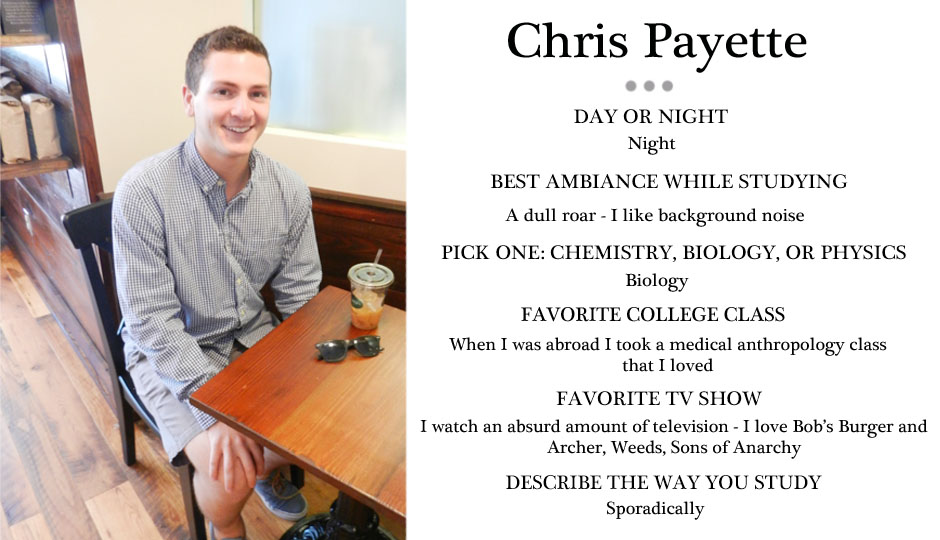
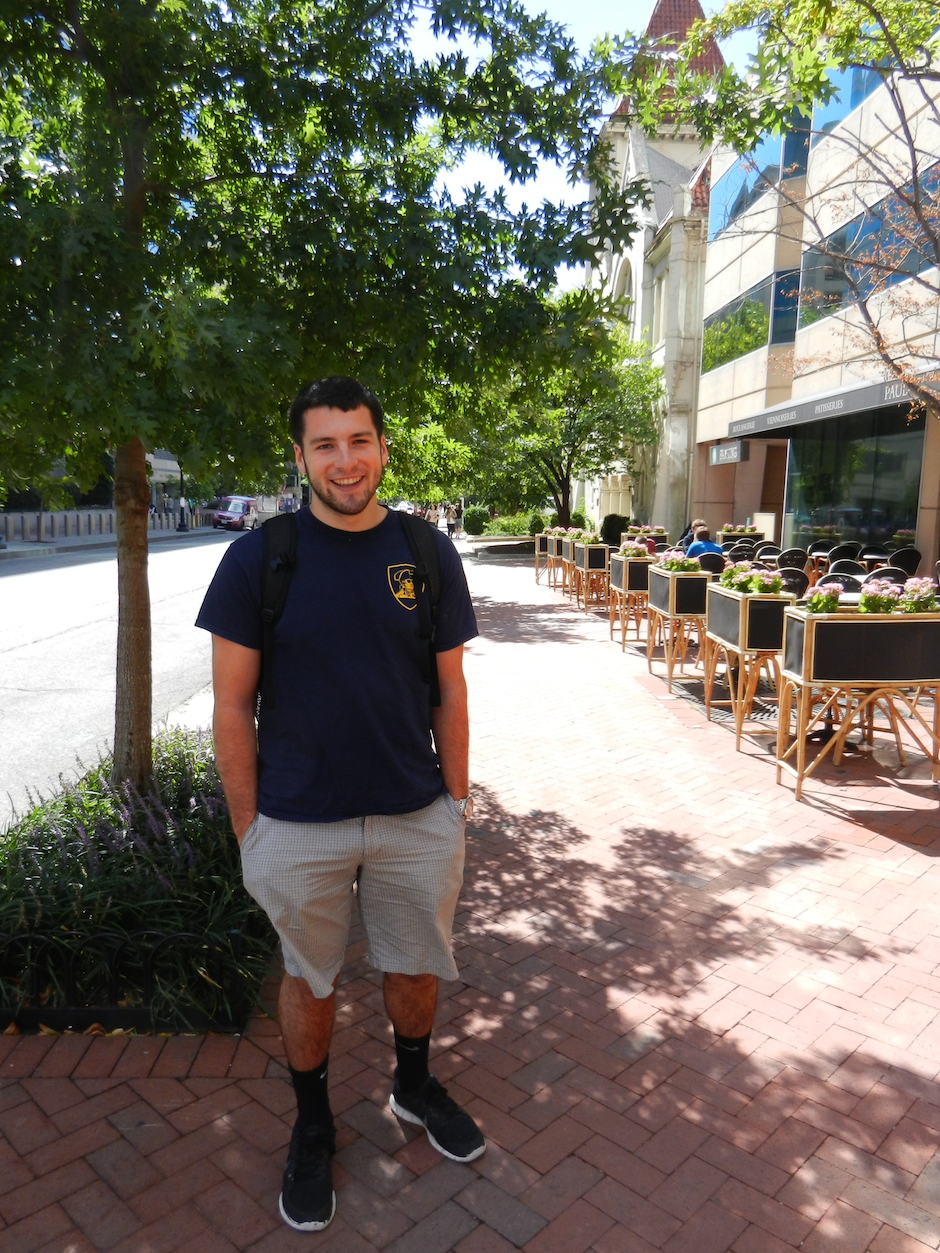
Every year a handful of students are accepted to the George Washington University’s Seven-Year B.A./M.D. Program. What that means is that seniors in high school who know that they want to attend medical school after earning their undergraduate degrees apply to this highly selective program and earn both degrees in a shortened period of time. We know, it’s pretty crazy-impressive. We had the opportunity to sit down with Chris Payette, a member of this program, recent GWU undergrad alum, and current first year GWU Medical School student. He gave us the low-down on what it takes to get academic work done while balancing work responsibilities and personal time. While it’s no easy feat, Chris somehow manages it all and does it with a genuine smile on his face. From sharing his successful-study-secrets to details about his semester abroad in South Africa, Chris is without a doubt seizing his youth and making the most of every opportunity.

Name: Chris Payette
Age: 21
Education: B.S. from the George Washington University Columbian College of Arts and Sciences | The George Washington University School of Medicine and Health Sciences
Follow: LinkedIn

Carpe Juvenis: How would you define “Seizing Your Youth”?

Chris Payette: Doing whatever you need to do right now that will set you up to be doing what you want to be doing later, whether it’s in the immediate now or in the future. So for me I think it’s much more for the future. Obviously right now I don’t necessarily want to be spending all of my time in the library studying, but – and I know this might sound slightly morbid - it’s a means to an end.

And also to make time for yourself and your friends and family. When you’re trying to make things the best for you, sometimes you don’t necessarily think about the whole picture, and other people’s happiness. But I think that it’s important to make time for the people you care about.

CJ: You knew from a young age that you wanted to study medicine, but what would you say to someone who doesn’t know what his or her passion is yet?

CP: Do everything. I do everything and it’s interesting because even though I’m in medical school I feel like there are so many other things I could do and be totally happy with. And it’s nice to know that even though I have a set path, there are so many other things I would be super happy to do. I’ve worked at restaurants for a while now, and I know that if anything ever happened with the medical stuff I would be happy waiting tables. I think that not having a diverse experience limits you. By trying a little bit of everything you can find what you like, and if you don’t know yet then you should keep trying everything.

CJ: What tools do you use to keep yourself organized and on track?

CP: Notability. iCalendar. Honestly so many. I try to reevaluate where I’m at and where I need to be at the end of every day, just so I can know where I am for the week, where I am for the month, where I am for my next exam, where I am for the next social event I want to go to. For example if I have a lot of friends in town and I know that I’ll want to set aside Saturday and Sunday to just see people, I’ll do extra schoolwork during the week based on how my overall schedule looks.

CP 2

CJ: How do you prepare for medical school exams?

CP: First I go through all of my lecture notes individually. I compile all of the “learning objectives” from each lecture and sort them into files based on what I think would be best to study together. Then I go through each learning objective and I add in everything pertinent from the lecture into one lengthy document. I include images as well. I go back to that document about two weeks before an exam and transcribe that onto one hand-written page. That page is what I use up until the exam to study – I really condense the information.

I use so many tools for this process – my suite of Microsoft tools, my Apple tools, my favorite Sharpie fine point pens and white printer paper. I just started using this system in med school and it’s been going really well. It’s good because it makes me first synthesize the data, and then condense it and get the most important pieces from it. That study sheet is when I really have to master the material, because one sheet can take one to two hours to make. A lot of it is just planning.

CJ: You went into college knowing that you would also be going to medical school – did you ever have moments of panic/anxiety about that decision? How did you overcome that?

CP: I get really excited about things. So there will be times when I get excited about one thing and think “I want to pursue that! That should be my job!” And knowing that it wouldn’t be, since I was already accepted into medical school, was weird sometimes. I went into high school in a magnet science program, so basically by eighth grade I was already committing to medicine. Which is good because I’ve always known that this would be my path, but it’s also challenging to think that in undergrad had I not already been accepted to medical school, might my path have totally changed?

I think for me personally it’s good that I have that structure, and I think that at the same time it gave me the freedom to have those moments of exploring other things because I knew that once I was in medical school I would have required responsibilities. So for example my research in undergrad was totally unrelated to medicine, my jobs were unrelated to medicine, volunteering was not clinical at all. I didn’t do one clinical thing at all in undergrad. So I had that time and ability to purposefully explore while I had the opportunity.

CJ: What’s the best piece of advice you’ve been given?

CP: Wow, I don’t know. That’s tough. One big thing that has always stuck with me is that my dad always tells me that regardless of being on the medical track, I can still do whatever I want. I think that a lot of people are pushed in one way by their parents, but my parents’ professions are not medically related at all. So it’s nice knowing that if at any time I don’t want to do what I’m doing anymore, hearing that out loud from my parents has helped me feel a little bit freer. Just knowing that I can pursue whatever I want in my career has been very comforting.

CJ: What advice would you give to a freshman starting the same 7-year program you are part of?

CP: Do everything that you want to do. You’re already accepted to medical school, you have your future laid out, so right now is your time to travel and see your friends and family. It’s your time to make art, go outside, be able to do stupid things and ask for guidance. That’s another thing – not that there’s no guidance when you graduate, but when you’re in undergrad there are built-in systems of support to hold your hand and help you get through college. So seek help, get mentors. There are no office hours when you graduate. The only office you’ll get to go to once you graduate is your boss’.

CJ: How did you get involved with Street Sense as in intern?

CP: I took a lot of service learning course at GWU because one of the things that’s expected of you going into the medical field is to always have volunteer experience. I like doing service learning because it’s was a really easy way to integrate that into my life and schedule. During my last year of undergrad I took an urban sociology class and that’s how I got connected with Street Sense. From there we created a role where I was in charge of social media. So I worked not only with the people who sell the newspaper, but also with the administrative back end. I really liked it so I stayed a little bit longer after the semester ended and worked with them in a larger capacity. It was an amazing experience – you get to meet a lot of really interesting people when you’re working with the homeless community.

CJ: What is your favorite book?

CP: Rant: The Oral Biography of Buster Casey by Chuck Palahniuk.

CJ: Despite being in a shortened 3 year undergraduate program, you still made the time to study abroad in South Africa – what compelled you to make the choice and how has it influenced you?

CP: I went to South Africa the summer after I did a GWU orientation program. The summer had been a lot of DC and a lot of GWU. It just felt like too much. I needed to spend the semester away, so I applied to go abroad. And I decided very last minute - my parents mailed me my passport the week before applications were due. I really just needed a semester away to experience somewhere different and travel without doing it during the summer. I followed my instinct to go somewhere. I would go back in a heartbeat – I’m already trying. Certain programs at my school require you to travel and work abroad, so I definitely think ill go back at some point.

CJ: What does a day in your life look like?

CP: It depends. My schedule varies day to day because of classes. Some days I’ll go to class at 8AM and end around 6PM, even 8PM. Other days I have independent study so I’ll wake up, make a cup of coffee, sit in my living rom and study. I’ll usually stay after class in the library most days just to do a little extra. I also work at Cove because I can get work done, and at a restaurant some nights. I try to have most of what I’m doing planned out a few weeks in advanced.

CJ: What advice would you give your 17-year-old self?

CP: Start exercising now, because when you’re 21 your metabolism will stop. And also do whatever you want. But seriously, exercise. I took a health class freshman year and one of our assignments was to make a behavior change. Mine was to start running, and I’ve been running ever since.

Chris Payette Qs

ideas
Skills

By the end of a tough year of school, it’s easy to get burned out. Even if you’re not in school, doing the same routine everyday can bore you. That doesn’t necessarily mean you should avoid learning all together though. The more you use your mind, the better it will be. Here are a few ways to have fun while improving your mind:

1. Read

We all have those books we want to read if only we had the time. If you have the free hour, take the time. You may not be able to finish your book for awhile, but reading will transport you to somewhere else. More importantly, your brain will still be working on a new task while you’re relaxing.

2. Do Puzzles

Puzzles are an easy way to challenge yourself. This can include classic puzzles, Sudoku, crosswords, or any other puzzles you can think of. You’ll get a fun sense of accomplishment when you’re done.

3. Learn A New Skill

If you’re bored or burned out in your every day life, introducing something new can be just the change you need. Learning a new skill will challenge you in a new way. Plus, maybe you’ll learn something useful like how to cook.

4. Free Write

Writing is a good way to free your mind of distractions. Have you ever had a problem focusing because something was weighing on your mind too much? You can write a story, a letter or anything else you want to get out. You can unburden yourself and improve your writing at the same time. You could even create a new masterpiece.

5. Get New Experiences

You never know how many new things you will learn just by getting out there and doing something that you’ve never tried before. Even trying a dish you never had before will give you a new experience. When traveling, you have to train yourself to know your way around which will give you a sense of direction. Meeting new people will strengthen your memory when you have to learn faces, names, and details. It will all expand your mind while being perfectly painless.

Get out there and try to re-energize yourself. Don’t stop learning. Taking a little time out of your day to improve yourself will be helpful in the long run, even if it is something as simple as taking an hour to read. Be your best self and have fun doing it!

How do you keep your brain active?

Image: opensource.com

Matt a
Professional SpotlightSpotlight

We love discovering people who are just as passionate about reading as we are, and Matthew Richardson is one of these people. We learned about Matthew Richardson through his company, Gramr Gratidue Co., which helps people make gratitude a habit through the form of thank you notes. Amazing, right? Matthew’s campaign to start a cultural movement for gratitude involves encouraging others to send thank-you notes, articles on The Huffington Post educating people on how to incorporate gratitude into their lives, and by sending thank-you notes himself. This is exactly the type of campaign we can get behind 100%.

Matthew is passionate about his pursuits, and when he finds something that moves him, he explores it further. Case in point: Matthew took a year off during his studies at Claremont McKenna College to hitchhike across 14 countries after reading the works of Henry David Thoreau. Inspired yet? Even now as a busy entrepreneur, Matthew makes time to read, write, remain curious about the world around him, and express gratitude daily. And we couldn’t agree more with the advice Matthew would tell his 15-year-old self: “Read.”

Name: Matthew Richardson
Age: 25
Education: B.A. in Literature from Claremont McKenna College
Follow: Gramr Gratitude Co. / Twitter / MattRyanRich.com

Carpe Juvenis: How do you define ‘Seizing Your Youth’?

Matthew Richardson: I think that it means very nearly the same thing as “Seize the Day” — that is, for as long as you’re able to see the importance of taking ownership of your own life and circumstances, then you have that spark of youth in you… you have as much energy and passion as it takes to create something of value for the world.

Also, I may be biased but as an entrepreneur with an academic background in Literature, I can’t help but equate siezing one’s youth or life or day, with creating something artistic, something that wouldn’t otherwise exist if you didn’t step up and pull resources together to make it happen.

CJ: You majored in Literature at Claremont McKenna College. How did you determine what to study?

MR: Like most every undergraduate I changed my major a few times before hitting my stride. I started out as an economics major with a focus on finance… but really couldn’t get passionate about anything that I was learning. It seemed both overly practical and totally impractical. I saw the value of economics in everyday decisions, but that very fact seemed soul-less to me.

I took a course in Russian Literature, read Tolstoy; which allowed me to see the infinitely reaching application of classic literature and philosophy. This led to Thoreau, which caused me to leave CMC for a year and hitchhike/camp across 14 countries, and read everything I could get my hands on. I returned to school with a passion for literature, and I felt as if I had made up for some lost time by reading dozens and dozens of classic works during that year off. Without going into it deeply here, I feel as though Literature is the best liberal arts discipline if your interest is ultimately in becoming an entrepreneur.

Gramr 1

CJ: You are the Co-Founder of Gramr Gratitude Co., a company that helps people make gratitude a habit through the form of thank you notes. What inspired the idea for Gramr Gratitude Co.?

MR: In the beginning we wanted to shake up the greeting card game and create an alternative to Hallmark that was so cool and trendy that they wouldn’t be able to help but acquire it. Very quickly, Brett (my co-founder) and I found that we were trying to run before we could walk and that we also didn’t care much about greeting cards in general. One niche that was particularly compelling, however, was the thank-you note. It didn’t depend on a holiday or an obligation — it had the potential to suggest a lifestyle. Gratitude seemed very important to us, and often overlooked as a virtue because it had no tangible commodity to represent it.

Meanwhile every business under the sun was developing programs for social benefit — following the lead of TOMS shoes which gives one pair of shoes to underprivileged children for every pair of shoes they sell. Generosity, then, was booming, because you could wear it on your feet, or chest, or wrist. But gratitude didn’t have anything like that, and we decided to make a concerted effort at becoming the face of the virtue. It was a word and a concept that was up for grabs, and we were the first to market — now we are continuing to try to think of ways to cement our concept into the contemporary context that is consumed by technology and efficiency. It is challenging but infinitely rewarding.

CJ: What responsibilities do you have as the Co-Founder?

MR: I lead creative projects, design, and partnerships.

CJ: How do you and your Co-Founder balance the workload?

MR: My Co-Founder is in charge of operations and business processes. But there is huge overlap — we are both frequently consulting each other and helping carry different loads that fall outside of the bounds of our broad responsibilities.

CJ: What are the greatest lessons you have learned from running your own company?

MR: It’s very hard and there are many hundreds of things you don’t think about or plan on when idealizing a company from the outside looking in.

CJ: What do you wish you had known before starting Gramr Gratitude Co.?

MR: That your website should be a minimum viable product because building something before you know how people will interact with it is a guessing game. We guessed wrong on several things, including our web host, and e-commerce platform. Both mistakes that are costly and time consuming to redevelop.

Gramr 3

CJ: What advice do you have on how to finance and budget when running your own business?

MR: In the beginning, ask people you know, who you trust, and who can give you more than just capital. We happen to have a very strong core of advisors, and that is more important than capital. We also raised 63k on Kickstarter. Crowdfunding is a good option for bootstrappers, but it also has scores of drawbacks that you can’t know until you’ve been hosed by them.

CJ: What can a teenager or young adult who wants to start their own company do now to set themselves up for success?

MR: Read.

CJ: What would you say to people who are uncertain about starting a business? What motivated you to take the leap?

MR: Surround yourself with people who fit more into a day than you fit into a week.

CJ: You write articles for The Huffington Post about gratitude. What are your favorite ways to show gratitude?

MR: Writing thank-you notes, or Gramrs. Especially to people who wouldn’t expect it. One of my favorite thank-you notes I ever wrote was to the server at Dr. Grubbs, a year after I last went there, for being such a joyful and wonderful person over the few years that I patronized that incredible restaurant.

CJ: You are an avid reader. How do you fit reading into your day, and which book has had the greatest impact on you?

MR: When I am in a good rhythm I am getting up at 5am and reading for an hour before I start my day. This allows you to get through about a book a week. This is my favorite time of the day.

I recommend East of Eden by John Steinbeck to everyone I meet. Sometimes before I introduce myself. It is enormously valuable.

CJ: Describe a day in your life.

MR: Wake up at 5. Make coffee. Read for an hour. Write for an hour. Sometimes workout for an hour. Start trying to get through the three biggest priorities I’ve set for the day — try and finish this before 12. Meetings, calls, work from 12 to 6-ish. Wind down in a variety of ways. Drink wine and Yerba Mate. Try and read some more. Write down the three things I must get done the following day before noon. Go to sleep ~11pm.

CJ: How do you balance your career roles and goals? How do you stay organized and efficient?

MR: This is something I constantly try and optimize — but OmniFocus is good, and Mailbox App keeps emails organized and out of the way. The best thing I’ve found is that figuring out what the three things you need to get done before noon are is the best way to get stuff done.

CJ: How do you like to enjoy your free time?

MR: I read, eat tacos, spend up to 10 minutes creating cups of single origin coffee, and tinker around with a handful of side projects.

CJ: What advice would you give your 15-year-old self?

MR: Read.

Matt Rich Qs

novel
Culture

October is drawing to close. Leaves are falling, the air is crisper, even the famous Pumpkin Spice Latte has made its triumphant return. For students, this final transition from summer to fall, and into winter, marks the time to buckle down and surrender to the tsunami of work that is imminent on the horizon. Such are the changes implied by the coming of November. For book fans and writers alike, the month of November marks the end of Booktober (a celebration for book lovers to read as many books as possible) and the beginning of Novel November.

Unbeknownst to most people, November is actually National Novel Writing Month, and last year there were over 300,000 participants. Of course, for most students, another assignment is the last thing needed, especially when the school year is just hitting its stride. However, the point of Novel November isn’t to layer more work on top of everything else. It’s to find something that inspires you, and to run with it as far as you can. It also helps build self-discipline by writing a little bit every day. And the end result is the best of all – at the end of the month, if all goes well, you’ll have your very own novel. It never hurts to try, especially if writing is a passion you’re attached to, but you just can’t seem to find time. At the very least, you’ll have a start-up that will continue to grow into something spectacular.

There are a few simple things you can do to keep yourself on track during Novel November:

1. Schedule a specific time each day to write.

It’s just like working out or practicing an instrument; as long as you dedicate a small chunk of time to it each day, your work will grow exponentially. Sure, that might mean dropping an hour that normally would’ve been dedicated to Netflix or scrolling through the Internet, but consider it time well spent.

2. Never leave your story on a cliffhanger.

I know from experience that if you leave your writing on a cliffhanger without a solid idea of where the plot is going to go next, it will be a struggle to try and figure out how to resolve the conflict in question, however brilliant it may be. Always know where you’re going, and putting in that extra hour will be easy, just a continuation of an idea you had yesterday.

3. Stick with it!

Rome wasn’t built in a day, as the saying goes. A book won’t just spring up out of nowhere; it’s a project that has to be pieced together chapter by chapter, day by day, and as long as you stay committed to it and manage your time wisely, by the end of the month, you’ll be a novelist.

Will you be participating in Novel November?

Image: Tim Geers

Abbey Bookstore
Culture

Everything’s quiet. No outside noise, no blabbing people. The only sound is the quiet whisper of pages turning, and the occasional low voice. Ahh, bookstores… a place for every self-proclaimed literary nerd to find sanctuary. Books will always be a source of comfort, and with most people still avidly reading books, there is no threat to the literary society going extinct. So what’s happening to the bookstores?

Over the past few years, popular chains such as Borders (now bankrupt) and Barnes and Noble have been suffering heavy losses. What’s causing this alarming downward trend? Simple: the Internet. The Internet, in all its wonderfully convenient glory, is a staple in the lives of almost every person on the planet. However, with the ability to have nearly all the information, shopping, and entertainment one could ever want at the click of the button, people have begun to overlook the physical world for the digital world, and nowhere is that more apparent than bookstores.

With plenty of shopping sites (Amazon being the most notable) available for people to purchase their books on, as well as eReaders and Kindles for people to read said books on, the need for an actual bookstore with actual print books is slowly decreasing, and while some may consider this a good thing, it also has a pretty severe downside.

The first reason, which is also very practical, is that a bookstore provides income for many people. Places like Barnes and Noble, or even the local neighborhood store, provide jobs for people in the community.

Secondly, bookstores allow book nerds (myself included) to meet other like minded literary junkies. Additionally, bookstores broaden the number of books that can quickly be obtained (let’s be honest – books aren’t cheap, and having to pay shipping, or even worse, wait several weeks for new books to arrive, is much worse than just traipsing down to the store).

Lastly, bookstores create a haven for people to simply enjoy being around literature. For myself and others, just being around books provides a calming influence, and being surrounded by as many as a bookstore provides is one of the best feelings in the world. The simple presence of all that literary magic is enough to warrant a trip to the bookstore. It’s a feeling unavailable on the Internet, and one that should be preserved forever. Booklovers, literary geeks, and anyone who loves a good read, unite. Bring back the bookstores!

EducationHealth

The semester is well underway and I’m sure, aside from getting involved in a gazillion clubs, juggling a job or an internship, and trying to have some kind of a social life, everyone is swamped with loads of homework. As I’m typing, many people are probably rushing to finish up their calculus problems or putting the final touches on a paper that is due in a few days. Whatever the case may be, there just never seems to be enough time in the day to get everything done.

Pulling all-nighters and working well after midnight aren’t unusual scenarios. We fall asleep on our textbooks only to wake up in the morning ready to fall back into the same routine. College is extremely hard and the moments when you get to kick back and relax are extremely rare. Even then, the days when you do get a chance to take a break from schoolwork (i.e. the weekend) are usually not as laid-back as you would like them to be because there is always an exam to study for, a paper to write, or an assignment to complete.

They say coffee is a college student’s best friend, but spending the day (or even the night) working on homework isn’t the way to go about college because overworking yourself can cause your brain to melt into a pile of mush. Maybe that isn’t what really happens but, without the occasional break from schoolwork, you’ll eventually stress yourself out, and being stressed has many negative effects on your mind and body.

Whenever you’re at that point where you just want to rip your hair out, step away from your computer, put down the book you’re reading, and set aside that calculator. Your work will be there once you take a 10-15 break (or however long you think you need). It’s not going to get up and walk away, so use some of your time to rest your brain and stretch those legs because I’m sure you spend hours on end plastered to a chair (or your bed) whenever you do homework. If you can’t figure out to do with your free time, here is a list of things to do to help you unwind.

  1. Get a snack: Studying and homework is almost impossible to do on an empty stomach, so get something to munch on and something to drink so you’re not depriving your body of the nutrients you need. For better brain power, try eating healthy snacks. And no, potato chips are not an essential part of the food pyramid.
  2. Stretching/exercising: I have a friend who does lunges whenever she needs a break from doing her homework. You don’t have to do lunges, but stretching might be a good thing to do to keep your body from cramping up after hours of sitting. If you really want to get that heart pounding, try doing some jumping jacks.
  3. Read a book: And I don’t mean a textbook. Pick up a book that isn’t for school and read one or two chapters to get your mind off of your homework and allow yourself to slip into another world.
  4. Listen to music: Turn on your favorite band or singer and rock out to your favorite songs. You can sing along or dance or do whatever it takes for you to destress.
  5. Go for a walk: You don’t have to go too far, but you can walk around your residence hall or apartment complex a few times just to get some fresh air and get out of the confines of the four walls of your room so you don’t go stir crazy.
  6. Play a game: Games are a great way to keep your mind busy. More importantly, you get to have fun!
  7. Straighten up your room: I’m not sure about you, but my side of the room always seems to get out of hand whenever I’m studying or doing homework. I can’t do anything until my side of the room is in order and everything that was out of place is back into place.
  8. Check your email: When we’re busy with class and school work, sometimes we forget to check our inboxes to see if we received any important emails. Use your free time to make sure we’re not missing out on anything.
  9. Talk to people: Start up a conversation with your roommate, text a friend, or call a family member. It doesn’t matter who you talk to, but it’s important to get your mind off of your homework for a bit and what better way to do that than to converse with people about things that have nothing to do with homework.
  10. Set your alarm and take a nap: Of course I had to save the best for last. If you find yourself not wanting to do anything on this list, it might be time for a nap. After 30-45 minutes of resting your eyes, you should feel refreshed and ready to finish your homework.

There are a variety of things you can do to take a break from homework. Just remember not to spend too much time (more than an hour) taking a break. Also, don’t feel bad about taking a break. We all need one so our bodies and brain don’t shut down after hours of staring at the pages of a thick textbook or a computer screen. You might feel like there is not enough time in the day, but you have the power to make time, so try to work taking breaks into your schedule the best you can because you deserve it.

Image: Unsplash

max
SpotlightYouth Spotlight

It’s difficult to not think of Max Levine when we consider what it means to Seize Your Youth. Not too long ago we ran into Max at four in the afternoon on a Saturday, having just got off of his 24 hour shift as an EMT for the George Washington University Hospital. Despite his sleepless day, he was vibrant and excited to share what he had just spent the last 24 hours doing. It goes without saying that this is a person whose passion is contagious, and we are excited to share his experiences and advice with you. As a pre-med student at GWU, Max knows what it means to commit blood (literally), sweat, and tears into achieving his dreams.

Name: Max Levine
Age: 21
Education: B.S. in Biology and Spanish from the George Washington University
Discover: EMeRG

Carpe Juvenis: How do you define “Seizing Your Youth”?

Max Levine: I would define seizing your youth as recognizing the times when it’s okay to not care about the future or really anything in general and just do what you want to do.

CJ: What has been the most unexpected aspect of college?

ML: The most surprising part of college has been working as an EMT as a student. I never would have thought that this was even a possibility never mind something that I would take up as a hobby.

CJ: What motivates you to get out of bed in the morning?

ML: Mostly class and an urgent need to urinate. That and morning breath that even offends me.

CJ: What is the best piece of advice you’ve ever received?

ML: Do what needs to be done, but do whatever makes you happy.

CJ: What has been your favorite college class so far? Why?

ML: My freshman University Writing course called “American Myth Through Western Film.” This class was awesome. All we did was watch sweet old western movies and then write papers about them. Our final project was to make up our own plot for a film and then write a brief summary of what the movie would be. It was fantastic.

CJ: What does a day in your life look like?

ML: It starts with four scrambled eggs and some cold water ( I can’t stand room temperature water.) Shower, dress myself with pretty little thought regarding color/pattern coordination. I’ll usually go to class and end up skipping lunch. Then I’ll either go to EMeRG shift, the parasite lab, or then go do homework and end up going to sleep around 12.

ML 2

CJ: How did you get involved in parasitology? What are the benefits and difficulties with that work?

ML: The parasitology class is offered to undergrads and I took it for my major. I ended up volunteering in the lab because I needed some lab experience for medical school and ended up loving the people I met there. The benefits are incredible. I have been given many projects to work on that are getting me invaluable experience in research methods and lab work in general. I am getting published by the end of this semester and will be looking to get a phenomenal recommendation from my professor as well. The difficulties of the lab include the time commitment and the general frustration of failing science experiments however I would hardly say that these are difficulties. The pros outweigh the cons by a long shot.

CJ: What advice would you give to incoming freshman who want to be pre-med in college?

I would say to not worry about the other pre-med kids because they’re usually pretty obnoxious and will do anything to let you know when they’ve succeeded and you’ve failed. Get out and do other things and learn how to be a social human being. Although grades are important, you won’t be a good doctor unless you genuinely know how to talk to and relate to people in a sincere manner. Also be open to other options, there are plenty of other things to do for jobs in the BIO field, not just medicine.

CJ: You spent a summer working at hospitals in Chile. Could you please tell us more about that experience and how it influenced you?

ML: I worked in both a public and private hospital in Santiago, Chile for 3 months. The private hospital was much like any modernized hospital you would find in the US, just in Spanish. Working here, I had the privilege of observing numerous operations that ranged from gastrointestinal procedures to vascular complications. These were the best surgeons and doctors in the country (possibly the continent) operating in this hospital.

The public hospital was in a rough neighborhood on the outskirts of Santiago that treated about 1.5 million patients a year and was named the busiest public hospital in Chile. The building itself was an old tuberculosis asylum that was converted into a hospital and the majority of people that come are pretty short on cash. I had met a younger doctor at the private hospital that was also doing rotations at the public hospital so I would go with him to and from shift. Here I was able to get my hands dirty, so to speak, and I learned how to give stitches and was fortunately able to participate/assist in a range of surgical procedures. This included appendectomies, cholecystectomies (gallbladder removal), one leg amputation, and a handful of other procedures. The leg amputation was the most memorable by far simply due to the gravity of what was going on. A woman with severe diabetes had neglected an infection in her leg, which had led to the necrosis of the majority of her lower limb. We amputated the leg from just above the knee in order to saver her life. It was a powerful and surreal experience that I will never forget. I won’t get too graphic with this but the most profound moment was the moment the leg was cut free. I had been holding the leg in a fixed position from the start of the operation and as it detached, I remember holding the leg and just looking at it and taking in what was in my hands and what this meant for the woman who had lost this limb. It’s hard to say how this has affected me, however I know for sure that this will be a lasting memory.

CJ: You are double majoring with Biology and Spanish. Can you explain why and if it’s been worth it?

ML: I have been taking Spanish since the 6th grade. I can’t imagine my life without the ability to use Spanish in some way shape or form. Additionally, Spanish is a really useful language to know in this country and has helped me in the medical setting, being able to communicate with Spanish speaking patients. On more than one occasion I have had to use Spanish on a call with EMeRG and even more so in Chile. Learning Spanish has been one of the best decisions I’ve ever made and the Spanish/ South American culture is definitely a prominent part of who I am today.

CJ: Between academics, working in the research lab, working as an EMT, and spending time on yourself, how do you juggle it all?

ML: There are three categories in college and everyone can only choose two. They are: Social life, Sleep, Good Grades. I have chosen to have a social life and “good grades” (in my case just study a lot and get okay grades) and I don’t really sleep a ton. I take medication for ADHD every day and it’s an amphetamine, which helps to keep me awake during the days (don’t worry it’s prescribed). I’m also just used to being tired all the time so little sleep isn’t a huge deal.

CJ: What is your favorite city?

ML: Boston. Hands down the best city on the planet. I grew up in the suburbs of Boston and it’s a city with a great personality and is more personal that New York.

CJ: What’s your favorite book?

ML: The Curious Incident of the Dog in the Night-Time by Mark Haddon.

CJ: What advice would you give to your 15-year-old self?

ML: Don’t let high school get you down and don’t worry about your social status. The kids who peak in high school get what’s coming to them in college and don’t really amount to a whole lot. Don’t worry about what’s ahead; go run around without a wallet, cell phone or keys while you can because those days are long gone now.

ML3

books fall 2014
Education

Happy first day of autumn! Who’s looking forward to hot cocoa, scarves, and bundling up with a good read? To say that we’re excited would be an understatement. Now that summer is over, it’s time for a fresh reading list. Here are the eight books at the top of our reading list…

1. So We Read On: How The Great Gatsby Came to be and Why It Endures by Maureen Corrigan

fallread 4

2. How to Read Literature Like a Professor: A Lively and Entertaining Guide to Reading Between the Lines by Thomas C. Foster

fallread 6

3. The Human Age: The World Shaped By Us by Diane Ackerman

fallread 8

4. Yes Please by Amy Poehler

fallread 5

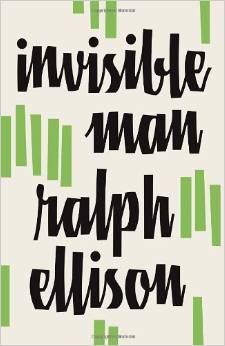
5. The Invisible Man by Ralph Ellison

fallread 2

6. Unspeakable And Other Subjects of Discussion by Meghan Daum

fallread 7

7. What If: Serious Scientific Answers to Absurd Hypothetical Questions by Randall Munroe

fallread 1

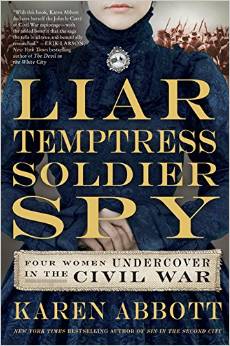
8. Liar Temptress Soldier Spy: Four Women Undercover in the Civil Wars by Karen Abbott

fallread 3

What books are you reading this fall?

Image: Abhi Sharma, Flickr

Chris Morgan outside
SpotlightYouth Spotlight

It’s always great meeting ambitious youth because it makes us motivated to do more. One of these go-getters is Chris Morgan, a student at the University of Washington and the director and founder of HuskyCreative. Chris is a writer, a musician, and a constant learner. He not only runs HuskyCreative, but he’s involved with the Pearson Student Advisory Board, works as a programmatic media specialist at Drake Cooper, and he somehow manages to find time to complete his homework. Oh, and did we mention that he is also writing a novel? We were fortunate to pick up some time management tips from Chris (note to selves: stock up on legal pads!), discover how he balances college with his jobs and activities, and hear more about what his post-graduation plans are. Chris seizes his youth, and he does it with a can-do, positive attitude. Now, get ready to take some notes…

Name: Christopher Morgan
Age: 21
Education: B.A. in Business Administration: Marketing from the University of Washington
Follow: HuskyCreative | Twitter

Carpe Juvenis: How do you define ‘Seizing Your Youth’?

Chris Morgan: Seizing your youth is about action. It’s about doing something. I know a lot of people who have great ideas, but the difference between the people who are hailed as seizing their youth and people who don’t is just the fact that they went and did something. Millennials are the generation to not get a job, so we made our own. I think that’s really cool – not the part about us not getting jobs – but we have the most entrepreneurs of any generation and we get out there and do things with our own ideas. Seizing your youth is doing something now.

CJ: You are majoring in Business Administration: Marketing at the University of Washington. What does this major involve and how did you determine what to study?

CM: I was originally a Music composition and Creative Writing double major. I wrote music a lot and it was going to be my career for the longest time, but as soon as I tried to make money off of it, I started getting really stressed out. It was hard for me to do creative work and have that be the way to put food on the table. I looked for other occupations that had that creative influence but wasn’t personal or my work really, and that’s how I found marketing. I can be creative but I still have time to do my personal creative work on the side. I made the major switch in the middle of my freshman year. It was a natural shift for me and it felt right. I was writing better as soon as I took that stress off.

CJ: What has been your favorite college class?

CM: I have two, for very different reasons. One is a branding class that I took this past year with a professor who really understood branding and how to talk to undergraduates. It was originally a graduate course, but he wanted to teach it to undergrads. He showed a lot of faith in young people. He said that there’s no difference between graduate students and undergraduates students, we just know less. Graduate students are earning their MBAs and have worked in the field, so they think that they know a lot. The cool thing about the class is that he knew we didn’t have that preemptive knowledge. We didn’t start class thinking we knew everything. We had an open mind and it was a really fun class.

The other class was one I took in Singapore. It was hard and awful. I learned so much from failing. I was in a foreign country and didn’t know anybody, and I did horribly in the class. But I know so much about that topic now – it was about Game Theory in terms of marketing and using strategic negotiation tactics. It was way above my head. But now we talk about it in classes, and I know more about it.

CJ: You studied abroad at the National University of Singapore. Why did you choose Singapore and how was that experience?

CM: I was between two options – I could go to Singapore or Sydney. I thought that Sydney was too close to the culture I had grown up in, and the culture I had never experienced before was Eastern culture. It was really the only opportunity where I could dive in and experience it. I chose Singapore, and I think it was completely the right decision. You learn so much about your own country and culture by visiting another. I understand education a lot better, actually. I got to see how Eastern culture education differs from Western culture education. That was one of the coolest things that came out of my experience, learning how two people can learn so differently.

Chris Morgan

CJ: You can speak Spanish fluently. What language-learning tips do you have for those who are interested in learning how to speak another language? Are there any other languages you want to learn?

CM: Yes, definitely! I want to learn Italian. When it comes to speaking a language, the only way to succeed is to speak the language. It’s about not being afraid to speak in front of other people. When you’re more confident in yourself and practicing a language, you will speak the language better. I think classes are better than a book and a tape because in classes you can talk to other people. If you do use a book or tape, talk to a friend or to yourself alone a lot.

CJ: You mentioned you work with Pearson. What is your involvement with them?

CM: I work for the Pearson Student Advisory Board, which is a board of students from around North America who have been selected to advise on education. Pearson recognizes that education will be changing with the new generation and technology. They are bringing in students to advise their development and business. I’ve really enjoyed it.

CJ: You were a programmatic media specialist at Drake Cooper, a marketing services company. What is a programmatic media specialist?

CM: Programmatic media is new form of media buying that is more personalized and digitally enhanced so we can learn about impressions. When you click on an ad, I can tell where you’re from, how much money you make, whether you have kids or a family, what kind of products you buy, etc. It allows companies to save money because they can pick who they send ads to. It’s more efficient for the companies, and in my opinion, better for the consumers because you’re not being spammed ads for things you don’t care about.

CJ: You have had multiple marketing internships. What experiences have been your favorite, and what were the biggest takeaways from those experiences?

CM: One of the more defining internships was the one I had at the Pacific Science Center in Seattle. It was one of my first internships, and the best thing that they ever did was let me have autonomy. They let me own something. They let me dictate the success or failure of a project. It teaches you a lot about taking ownership and being creative with your ideas. A lot of first internships entail getting coffee and managing a calendar. Having autonomy was important for me because it helped me understand how to be successful.

I worked on organizing events. I worked on live event marketing, and I got to take on projects by myself and have a real impact.

CJ: You are the Director and Founder of HuskyCreative, a not-for-profit advertising agency at the University of Washington AMA chapter. What responsibilities do you have as the Founder and Director?

CM: When I started HuskyCreative, I had worked in marketing but not advertising. I didn’t know anything when I started. I was the finance guy, the HR guy, and the Creative Director. It was such a growing experience. I was a totally different person then. It was such a ride. Our first client was Shell Oil, which was awesome and scary. We had no idea what we were doing, but we used that to our advantage because we created a campaign that nobody else had done.

We exclusively hire college students because their opinions aren’t tainted by past experiences. They have a fresh look, and that’s how we succeeded at first. Hiring the first people was new, managing finances, writing contracts, this was all new to me.

For what I do now, it’s pretty similar but it feels like less because I know what I’m doing. Instead of writing the first contract, I’m taking the contract I’ve already written. A lot of my work is managerial, and I don’t do a lot of ad work. But I love it, and it’s been really incredible. This next year we’re trying to build a collegiate network of creative agencies. We’ll be a support group for people who want to do what I do or who want a creative agency at their university. It’ll be a really exciting year for us.

Chris Morgan 2

CJ: You have one more year until you graduate. Is HuskyCreative something you want to do after you graduate?

CM: The goal of HuskyCreative is to be an experience for the students. The reason we started the agency is because of the first job paradox: “This is an entry level position, but we’d like you to have two years of experience.” When people graduate from school, they might not have that job experience and they might not have been taught the correct things about the ad world, so we wanted to create a place where students could get this experience.

I want somebody else to take my job because this experience shouldn’t just be my own. I hope that it continues on for many years. We built it to be sustainable over the years. We want to help people gain experience so that they can get a job.

CJ: Music is one of your passions. How does music play a role in your life?

CM: I started playing the piano when I was four, and when I was eleven I started playing the improv jazz saxophone. I write a lot of piano music, and I have written a symphony. I’m working on my second one now. A lot of my writing isn’t jazz, but it’s my favorite thing to play.

CJ: You’re a writer. Tell us about the novel you are working on.

CM: I am working on a science fiction novel. I’ve been working on it for too long now. With running the company, I haven’t had the chance to really sit down and write. I’m awful at just sitting down to write. I’ve heard many times that you can write a story as an architect or a gardener. As an architect, you write an outline and construct the character story arcs. Or you’re a gardener and you have an initial idea and just start writing. It’s hard for me to let things just happen, so I spent a lot of time building the story before actually writing it.

CJ: What is your favorite book?

CM: The Wise Man’s Fear by Patrick Rothfuss.

CJ: What is your favorite magazine?

CM: Ad Age.

CJ: How do you balance being a college student with all of your jobs and activities?

CM: School comes first. You’re at school to learn. Passion helps with balancing. You’ll find that you’re more stressed out when you have obligations that you’re not passionate about. I wouldn’t try to fit in writing music or my novel if I didn’t love doing those things. Time management is awful, it’s hard, and there’s no one trick that I have. I just keep doing things because I love them.

CJ: How do you plan out your days?

CM: I plan things out on a week-by-week basis. I am notorious for making lists. I love legal pads. I carry mine around with me everywhere. I structure my calendar around my weekly goals. I like the structure and pre-planning for what I have to get done.

CJ: What does a day in your life look like?

CM: I work a 9-5, so I go to work. I have a separate to-do list for work, where I set up what I need to get done hour to hour. As soon as I get off work, I shoot off emails for HuskyCreative, sometimes I have meetings. I’ll have dinner, take some time to relax, and then I’ll usually do more work for HuskyCreative, and then write. I try to end my day with writing, it’s relaxing and is something I enjoy.

When school is in session, it’s a little more hectic because I’ll be running from classes to meetings. I’m usually working or in class all day. I try to finish as much as I can before dinner. It’s important to have an hour or two to just do whatever you want, whether that is writing or watching movies with friends. Whatever it is, you need that time.

CJ: What advice would you give your 15-year-old self?

CM: Have action. In high school I had a lot of time. I had the original idea for my book in high school, and that would’ve been a great time to get started writing it. I had a lot of hesitancy, and I thought the idea was enough. It’s hard to have that motivation all the time, but if you have an idea and are passionate about it, do something about it. Everybody has ideas, but not everybody does something about it.

Kat Tanita 3
Professional SpotlightSpotlight

If you love fashion, beauty, décor, photography, or just amazing blogging in general, don’t miss Kat Tanita’s stunning blog, With Love From Kat. Kat styles beautiful outfits and has a keen eye for what’s trending in the fashion and beauty industries, and she shares her insight through photos and round-ups on her site. Not only is Kat a successful blogger with a polished chic style, but she is also savvy business owner who has learned a lot from her experiences. But now, let’s hear from the blogger herself…

Name: Kat Tanita
Age: 25
Education: B.A. in Design Studies from Arizona State University
Follow: Twitter / Facebook / Instagram / Pinterest / With Love From Kat

Carpe Juvenis: How do you define ‘Seizing Your Youth’?

Kat Tanita: Chasing your dreams and making them a reality.

CJ: What was your favorite class in college?

KT: I loved all of my design classes, but surprisingly my favorite class was Marketing senior year. It was neat to learn about the creative process and how important it is in an effective public relations and marketing campaign.

Kat Tanita 1

CJ: What are the greatest lessons you have learned from being a business owner and blogger?

KT: Ask questions, find mentors, have confidence but be humble, hire smart (get a good lawyer, accountant, intern, etc.) and learn from rejection.

CJ: What are your time management tips?

KT: Write everything down in a to-do list and take one thing at a time. Start the day and end the day with productive things, but give yourself a break in between. I always try to get out, take a walk and have a long lunch. It feels good to end the day with something productive – I can’t sleep if I don’t!

CJ: What does a day in your life look like?

KT: Every day is so different. Sometimes I’m at showroom appointments, press previews, meetings, and events. I’m always answering emails, exploring the city, looking for inspiration, shooting outfit pictures, and brainstorming for upcoming projects. I love to cook dinner and end the day with yoga, a run, or circuit training.

Kat Tanita 2

CJ: What advice do you have for youth who want to start their own blogs?

KT: Remember to be unique and original. Don’t try to copy others because what will set you a part is your individual voice and style. Do your research! I simply Googled “how to start a blog” 4 years ago and read so many articles/watched so many YouTube videos. Don’t be afraid to ask questions and find mentors. You should always be learning.

CJ: Which book has had a great impact on you?

KT: Grace was one of my favorite books this summer. I loved learning about her career path. She started from the bottom and worked her way up. She is incredibly talented.

CJ: What motivates you?

KT: My dad’s work ethic motivates me. He always said whatever you do, do it to the best of your ability even if it’s a small, menial task.

CJ: What advice would you give your 20-year-old self?

KT: Travel more, read more, and embrace your uniqueness!

Kat Tanita 6

Image: All photos by Kat Tanita from WithLoveFromKat.com

CASEY1
CultureHealth

Having sold over 100 million copies in 52 different languages and by breaking the record for fastest-selling paperback book, it is clear that Fifty Shades of Grey has left an impression on current readers. Not to mention the highly anticipated 2015 film adaptation and the board game- yes a game was actually made based on the book- to go along with the success of the franchise, one can only imagine why this novel has enraptured so many.

Since I am one of the few who have not read Fifty Shades of Grey or its sequels, I only have a superficial viewpoint of the books itself. But after reading an article by Edwin Smith of The Telegraph, I became curious about some of Smith’s points over the books influence and people’s reactions in their own relationships. Smith makes the point that in a very progressive era, specifically for feminism, Fifty Shades of Grey shows how our culture is still somewhat stuck in older gender roles- however in a more modern way- and how people today are willing to fit any norm to find a partner. Smith goes as far to say that for men “in 2014, we might often stand a better chance in the arena of dating if we appear to be a bit more like Mr. Grey, and a bit less like … well, ourselves.”

This point, though saddening, can be seen as somewhat true to today’s standards in relationships. For example, when prom season was rolling around, a girl I knew truly did not want her boyfriend to waste so much money on one night, so she paid for the tickets. However nice this gesture was, other girls thought it was bizarre because they truly believed that it was the guys place to pay for everything. And although the idea that one person must be dominant and the other submissive in the relationship no longer applies to all areas, it still exists in places such as who is paying for dinner?

These restrictions limit the amount of vulnerability and closeness that two people can share. If they were to act as themselves and not conform to roles, each partner would be given the opportunity to experience what a real, loving relationship feels like. However, people today are so engrained with stereotypes that it is hard to except people who are truly being themselves, who might spread themselves across many different types of roles instead of just the ones designated to their kind.

This alienation of total freedom from gender norms is how people get the idea in their head that they must change themselves to impress others and vice versa. One can find countless blogs and Youtube videos dedicated to how you should look or act to attract someone else. For example, earlier this year popular Vine maker Nash Grier posted a video about what he wanted from a girl. Albeit this video meant no harm, Grier received a ton of backlash seeing as he was telling his mostly young female audience how they should not be themselves to attain a guy. Yet girls are not the only ones who suffer from these pressures. These norms expect young men to be powerful and aloof, but do not allow them to be as emotionally invested in the relationship. Plus, we can’t forget how in gay and lesbian relationships society always expects one to be the “man” and the other the “women” of the partnership when clearly they are just two people enjoying a relationship.

Now, to an extent, it is debatable how progressive or digressive relationships like that of Grey and Steele in Fifty Shades of Grey is, depending upon how you view their dominant/submissive relationship and the entire nature of the book, but that is not the point. It is undeniable that the notion of changing yourself for love is predominant in the book, in other forms of media, and in our culture as well, and it is my hope that with a little more sensitivity to future partners that everyone can learn to use themselves to find their other half rather than looking to models of what people should be like because those forms are so grossly incompatible with modern day people and relationships.

Image: Unsplash